recent posts

Showing posts with label Ryan Quinn Flanagan. Show all posts

Thursday, July 4, 2019

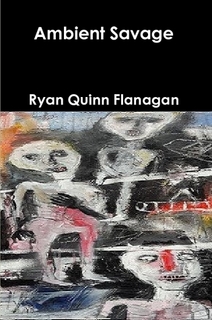
Book Review: Ryan Quinn Flanagan AMBIENT SAVAGE (Rust Belt Press, 2019) 280 pages


This is one of the latest collections of poetry by the prolific Northern Ontario poet Ryan Quinn Flanagan, who has amassed more than thirty-five books to date, most of which can still be bought through Lulu or Amazon. Check out his yolasite link below. The man's output is not surprising when you consider that on a good full day Flanagan can crank out 20-25 poems. Recently asked if he ever deleted a poem Flanagan confidentially quipped, “Hahaha! Yeah, I got a big pile of QC (Quality Control) that I box away when it’s not good enough so plenty of rejects for sure.” 

There are an amazing 199 poems in Ambient Savage and those familiar with Flanagan’s poetry will find both confessional verse combined with what he refers to as his “wandering poems.” He explicitly explained his use of style in an earlier BM review in regard to his collection Gangbangs and Other Mass Rallies (Pski’s Porch, 2017): 

“The more matter of fact confessional type poems are much more straight forward, and often the backbone of the book.  The other intricate word play or “wandering poems” as I like to call them are probably the best example of how my brain works.  They are non-linear, almost steams of consciousness, but not quite.  I honestly enjoy writing these types of poems more and more I find.  I don't consciously set out to do so, but I find that more of them are appearing in newer works.” 

The title poem “Ambient Savage” appears early in the collection. The highly associative word play in the poem is a remarkable example of Flanagan’s hugely experimental “wandering” poetry:

Ambient Savage

Big Brother is little sister
sharing a bunk

the fingers of lepers
always leaving the
band

and I walk into the room

and all the walls have been
ex-communicated

not a Latin bone in my body
so that fishy cans from Sardinia
mean nothing to me

that salty red taste of split lips
after a fight

the way you can leave yourself
behind in the snow
and be somewhere else
completely

your ambient savage
scabbed across distant
knuckles

drying in the street
that stolen joyride cars
drive over.

In the Gangbangs interview, Flanagan also explained the sense of artist freedom and joy he derives from his writing methods: 

“I have always loved surrealist paintings and Dada and such and the wandering poems allow me to jump around a bit like a frog stretching its legs a little… It is more a comfortable free association as you go along, not locked in on anything specific, but rather gliding through loose sentiments and never forcing a cohesion.  There often is a loose cohesion when you are done, but it is flexible and free and therefore often the most rewarding.”

You will find more than two dozen “wandering poems” in the collection. Here’s another stunning example:

Summer Comes

You reach
and come up
short

that is straight
carrot on a stick
bullshit

leading the horse
to glue

and the cars
that won’t start
come to rest
in the street

the neighbourhood
children try the doors,
then jump on the hoods

if there is a body in the trunk
the right people will
find it

with its testicles cut off
and shoved in
its mouth

or perhaps
this is a reckless
abandon

the plates removed
like loose teeth

and when the summer comes
it is hot

your clothes seem to stick to you
like cotton shadows

in the absence of trees
for shade

and books

for
school.

*

I have been following Flanagan’s work for over ten years and have been impressed by his tenacity to get the word down on the page.  Asked about his process of composition and how he arranges the order of his poems for publication, he candidly and generously replied:

“The process I follow for composition is pretty simple and repetitive.  I eat the same thing which is a bowl of oatmeal, then I listen to the same music to get in the right headspace. Usually some Ministry and Nine Inch Nails or Joy Division.  After that, I head upstairs with some wine or beer and switch to classical music from hard rock or industrial. The classical stuff is just nice and quiet like something in the background to help put you into a sort of trance so you just get to the business of writing without thinking about it too much.  I might have a few notes to jog the memory, but usually I'll just sit down and see what comes out.  If I have a full day to write I write until the wine or beer is gone. Then I turn the computer off and grab some dinner before bed.  I can't write everyday of course, we all have lives to lead and life stuff always intruded, but when I can I definitely make the time and just repeat the above process as many times as I can.

“When I feel the poems are written and the collection is ready to be assembled, I print out a hard copy and spread all the poems out on the bed so I can get a real good idea for the flow as I'm arranging. The flow is very important to me like building a strong album in many ways.  Some people can just do it on the fly on the computer, but I have to see everything laid out in hard copy and arrange things that way.  Then I take the assembled MS and rebuild it onto the computer with cut and paste until it is in an ordered MS form on the computer.  Then I read through and make any edits I have to, usually just a lot of little spelling and grammar things.  I almost never change anything that is written. I figure it was written during that specific time and headspace and just stick to spelling and grammar edits.   It is important to be totally sober for this part, can't stress that enough! "Write drunk, edit sober" is a mantra I certainly ascribe to.  

“After first edit, the MS is ready to be sent off to the respective publisher. The MS is then formatted into a PDF and all the line and spacing issues are dealt with. I do a second reading during this stage as well. When the corrections come back, I check to make sure everything is good to go and usually do a third cursory edit read while we work on the cover art and other important things that go into a work. Then the proof is ordered and we check to make sure everything is correct and transferred just as we wanted it to be. After that, we are good to go.  And that's the process for every book with little to no variation. Just certain things may be different depending on the respective publisher. But I really am a creature of habit when it comes to writing, that's for sure.”

As with Flanagan’s previous collections there is no unifying theme in Ambient Savage. As he explained in the Gangbangs review, “I much prefer to sit down and write whatever comes to mind over a couple of months, and then look at what I have in its entirety and choose from there. A few loose themes or motifs often appear, but overall, the idea is to just let things flow and see what comes from that; to mine the subconscious and make sure the conscious just gets out of the way as much as possible. When the poems are written, that is the way they are.”  

The poems in Ambient Savage were written over a short period of time two years ago and “in the same head space.” Flanagan writes of the process of getting this collection published:

“Ambient Savage was written about two years ago. I then approached the amazing artist Marcel Herms about his fantastic art for the cover. I love whenever I get a chance to work with Marcel.  We've worked together on five books to date and I'm sure there will be many more. Once I had the book written assembled and proofed and the cover art, I approached a press about working with them. To their credit, they got back to me and said they would like to publish Ambient Savage, but had so many books ahead of it in the queue that it would be over a year before they could get to it and suggested I see if I could get it picked up somewhere else in the meantime if I could. I was very appreciative of them being so upfront about the wait. That extra time would have put the poems at over three years old at that point. I then went over the MS again with yet another proof before I approached Rust Belt and Ambient Savage came about pretty quickly after that.

“As I mentioned, most the poems were written over two years ago and then there was a wait with the first press before the move to the second. The poems in this collection are their own beast and completely independent of the other collections. They were all written during the same short period of time and in the same head space.  And having Marcel's wonderful artwork grace the cover really brought everything together.  That guy is truly a great artist!”

*

The heart of Ambient Savage consists of confessional verse and narrative poems which include personal anecdotes and observations of everyday events, conversations with his wife and other women, his battle with mental illness and his thoughts on writers and writing. The writing is typically clear and easy to follow. 

In the poem “Key Development” Flanagan uses a simple trip to get a key cut into a memorable experience for the reader:

Key Development

I am in this little closet of a shop
down by the water.

Having a key made for my new place.

This old timer in a candy-striped smock
standing over the buffer.

A wrinkly stooped Polack
with large brown growths
on his face.

There are many locks on the wall as well.
I check the one on the entrance to the shop
figuring this old timer would use the lock
he trusted the most.

There is no open or closed sign.
No one comes in while I am present.
I doubt they even know it is there.

It’s the type of place you walk by
a thousand times without thinking
about it.

When the key is done, the old timer
charges me next to nothing.

I thank him and he nods.
The same way creepy butlers do
in old horror movies that don’t
end well.

Then I am out the door
and back into the
world.

With a shiny new key
tucked inside a small white
envelope.

Past the movie house crowd
spilling out
and date night diners inside
restaurant windows.

Knowing the quietest one in the room
is the strongest one
in the room.

And your noise is the sound of
their victory.

Perhaps the consistently best in the collection are Flanagan's portrait poems, usually of struggling, marginalized people who appear in poems such as “Evgeny the Loan Shark”, “The Dope Dealer”, “Stanley’s Creation”, “Chop Shop”, “Gridlock Gary”, “Luke” and “$5 Cum Dumpster.”

*
Ryan Quinn Flanagan recently expressed to BM the evolving role that writing has had in his life, "I used to think that writing just played a cursory role in my life, but as I've gotten older I think it plays a much more therapeutic role than I previously thought. I used to laugh at that idea and I still have some problems with the idea of that, but writing really does help me. It just calms me more than anything and allows the opportunity to do something I enjoy doing as opposed to all the things we all have to do in daily life that aren't enjoyable in the least. Some of those daily things can be soul crushing really, so it's good to have something you can go to that makes you feel good, you know? And because it is so enjoyable I try to make time to do it whenever I can."   

*

You will find plenty of surprises in Ambient Savage. When you think you have Flanagan worked out he will fling your way a remarkable line or a poem to blow you away. That said, a few of the poems in the collection appear comparatively weak and perhaps this is due to Flanagan’s massive output, his bold experiments in language, and especially, his rigid determination not to revise his work once it is down. 

He says candidly in the Gangbangs review, “I never revise anything beyond simple spelling and grammar issues.  I believe that when you write, what came from that day, that specific time and space is specific to that place and not to be polished up or amended later on when you find yourself in a completely different headspace.  I don't want to censor anything I may say, so I just go with my first natural instinct and trust that.”

Ambient Savage is an interesting and solid collection of poems. Flanagan is up there with the best of the alternative small press. And as he is still only in his early 40s we should expect dozens of books to follow. The poems may not always work but you have to admire Flanagan for his ongoing experimentation with language and his tenacity in getting his work to us out there. 


Check out dozens of other books by Ryan Quinn Flanagan here: http://ryanquinnflanagan.yolasite.com/books.php

Find a BM review/ interview of Flanagan’s Gangbangs and Other Mass Rallies(2017) here: https://georgedanderson.blogspot.com/2018/01/ryan-quinn-flanagan-gangbangs-and-other.html

March 16, 2019 Interview with The Dope Fiend Daily:    https://thedopefienddaily.blogspot.com/2019/03/interview-with-ryan-quinn-flanagan.html

Wednesday, December 5, 2018

Book Review/ Interview: The Asylum Floor #2: Literature With A Sledgehammer (2018) 110 pages


This is the latest edition of the literary journal edited by Brenton Booth. It features the poems, short stories and illustrations of alterative small press icons such as Wolfgang Carstens, Victor Clevenger, Ryan Quinn Flanagan & many others, as well as the poetry, sketches and cover art of the late great Jack Micheline.

Standouts in the anthology include Matt Borczon’s post- Afghani PTSD poem, “Everything Is Just Because It Is”, Dave Roskos’s dry wit in “Analogue”, Clevenger’s poems “Forced Sober” & “She Had Never Tried Wine”, Janne Karlsson’s mad but profound scribbles and Wolfgang Carstens’ short story “The Human Zoo”.


Yesterday, I asked Brenton a few questions about his involvement in this project: 

INTERVIEW WITH BRENTON BOOTH 4 December 2018

What was your overall idea for the book?

As a writer I am constantly aware through my personal submission process and reading modern lit mags of the 'no go' zones for publishing. Writing that says a lot, writing that challenges, writing that purposely seeks to disgust, writing that aims for more than words on a page, writing as a reward in itself, writing to live. The purpose of The Asylum Floor is to give a platform where good writers can express themselves without the censorship of publishing. The Asylum Floor is also about promoting each writers work as best I can. Each issue I purchase over 100 copies that are distributed internationally through the contributors in their local areas to get every ones’ words read by as many people possible. It comes at a cost, but I believe in every writer I publish and the importance of good writing, and that is far greater than money. 

What do you mean by the phrase "Literature with a sledgehammer?"

It is a homage to Friedrich Nietzsche who has had a big influence on me as an artist. It is also the theme of the journal. The Asylum Floor isn't about subtlety; it is about making a statement: preferably a violent one! 

How did you go about selecting the writers and sequencing their order in the book?

I read a lot of lit mags and the writers I admire and think are suitable I contact. Obviously there are still many I haven't published yet. But if I continue with the journal I eventually will. There are also great writers that I like that simply aren't right for the journal. Just because I don't publish someone doesn't mean I don't like their writing, I am no judge of good or bad writing: no one is. I simply publish what I think is right for the journal. I have been pretty fortunate so far. Everyone but one person has accepted my offer to contribute. And they have all sent some fine work my way. Once I accept the work for the issue. I read over it all many times. And put a lot of thought into the best order. My idea is to get a nice journey for the reader rather than just arranging it alphabetically. I hope I achieve this. 

How did you find the editing process?

I enjoy it. I get to work with great writers I admire. And see really good work. Some writers I specifically ask for certain things from. For example, from Catfish McDaris I requested nonfiction on artists. He contributed great pieces on Van Gogh and Dali. Other writers I have requested specific pieces I had previously seen and thought would work. Though the majority of the work in The Asylum Floor is previously unpublished. Getting the right material and putting it together is a lot of work, but also very rewarding.

How did you obtain material from the Jack Micheline Foundation?

I originally asked contributor Catfish McDaris if he could write a nonfiction on his relationship with friend Jack Micheline and the publishing of their chapbook "Prying", which also included Micheline's friend Charles Bukowski. Catfish wasn't able to but recommended the amazing Micheline poem "It Is Not Here On Earth What I Am Seeking" and recommended I contact Jack Micheline's son (a friend of his) to get permission to use it. I did and he was fantastic. He gave me permission to publish the poem and also sent me several of Micheline's paintings to use for the cover image and in the journal. He was very generous. And I am honoured to publish his father’s great work. 

Will there be a #3?

Not sure yet. Good chance though. 


Brenton Booth is a Sydney, Australia writer. His upcoming book Bash the Keys Until They Scream will be published by Epic Rites Press in January 2019.

Wednesday, January 10, 2018

Book Review: Ryan Quinn Flanagan. Gangbangs and Other Mass Rallies (Pski’s Porch, 2017) 190 pages


Gangbangs and Other Mass Rallies is prolific Canadian writer Ryan Quinn Flanagan's latest stab at poetry. The book consists of 157 typically short, highly accessible small press poems. The collection is highly varied in subject matter and form and includes childhood anecdotes, personal reflections & opinions, confessional verse, portrait poems, list poems and cryptic “wandering” poems. In the underground tradition, there is undercurrent of violence, of dead-end jobs, of drug taking, of barely tolerable relationships in many of the poems.

Gangbangs is the thirty-eight year old Flanagan’s 24th stand-alone volume. In the interview which follows this review, Flanagan explains his usual intuitive method of putting a book together, “I have never really liked writing from a single unifying theme. That process seems limiting and constricting to me. I have tried it and don't find that process very enjoyable. I much prefer to sit down and write whatever comes to mind over a couple of months, and then look at what I have in its entirety and choose from there. A few loose themes or motifs often appear, but overall, the idea is to just let things flow and see what comes from that; to mine the subconscious and make sure the conscious just gets out of the way as much as possible.”

The cover is designed by Mark Pietrzykowski, the publisher of Pski’s Porch and appears to be of an African-American rally from the Depression era or perhaps earlier. Flanagan says of the cover, “Marc has access to this great mass of New York photo library archives which is fantastic to look through. For the front cover I knew what I wanted and began looking out old rallies in the archives. The images had to work with the title as well as placement of the title. I sent a mock up to Marc, and he had it done and back to me in an hour. It was perfect.”

The title poem itself is cheeky and perhaps an extended metaphor of Flanagan’s “singular purpose” to get the writing done at any personal cost. He says of the poem, “I do tend to like choosing a book title from one of the poem titles and "Gangbangs and Other Mass Rallies" seemed the most catchy.  Besides that, the poem conveyed some of the loose overarching themes I wanted to address such as individual alienation in a mass urban society.”

Gangbangs and Other Mass Rallies

There is nothing wrong
with large numbers
of people
working towards a singular
purpose
unless of course,

you are that singular
purpose.

And you find that-
with arched back
and ass
in the air-
you have
their undivided
attention.

(all poems in this review have been posted with the permission of the poet)

Flanagan writes honestly and urgently and with little revision. He is experienced and confident enough to be ruled by his instincts, “When the poems are written, that is the way they are. I never revise anything beyond simple spelling and grammar issues. I believe that when you write, what came from that day, that specific time and space is specific to that place and not to be polished up or amended later on when you find yourself in a completely different headspace. I don't want to censor anything I may say, so I just go with my first natural instinct and trust that.”

His poem “Distance Runners Miss the Point” appears to sum up Flanagan’s usual take on writing- be simple & direct & use your words economically:

Distance Runners Miss the Point

it is best
to say a lot
with very
little.

Most say little
with very little,
or even worse,
with a lot.

The more words
you need,
the more you have
failed.

Everything
simple and poignant
and direct.

Flanagan says of the poem, “It does sum up my personal view of writing pretty well. I do like to wander at times though, to play with words and images and strange ideas. But in the many quasi-narrative type poems my natural approach seems in keeping with the aesthetic laid out in "Distance Runners Miss the Point." Life is short and we're not here for long, so it's best to say what you mean and get on with things before you're dust and can't anymore. I find such a simplified approach is much more relatable to the reader as well.”

Upon closer examination, Flanagan appears to use two different styles in Gangbangs.  In the solid core of book, the poet uses well-honed conventional underground verse. The best amongst these include “Talking Shop”, “Sporting Goods”, “I Started Thinking of Jesus”, “Hoover”, “Attrition Monger” and “Burial Wrongs”. Alternatively, Flanagan has written about a dozen or so extended cryptic, associative poems which he calls “wandering poems”. The best amongst these is perhaps the five page “Long Lines at the Grocers so Cars can be loaded full as Sniper’s Rifles” but also impressive are poems such as, “Bloodlust & Chicken Wing”, “White Rhino”, “Aggressive Sales Tactics Like Swallowing a Shotgun for Breakfast”, “A Box of 100 Letter Sized File Folders” and “Punctured Lungs & Cryostasis”. The poems are usually set in public places like a bar, mall, park or public library or bathroom. What follows is a series of triggered thoughts and layered associations which jigsaw down the page and collect like a multiple car pile-up.

Flanagan says of this second, more complex style, “The wandering poems as I like to call them are probably the best example of how my brain works. They are non-linear, almost steams of conscious, but not quite. I honestly enjoy writing these types of poems more and more I find. I don't consciously set out to do so, but I find that more of them are appearing in newer works. I have always loved surrealist paintings and Dada and such and the wandering poems allow me to jump around a bit like a frog stretching its legs a little.”

The poem "Beds that are also Couches so the Efficiency Expert can Sleep at Night" illustrates this challenging homegrown style:

Beds that are also Couches
So the Efficiency Expert can Sleep
At Night

The water falls over your hands
like liquid spastics
into a sink basin beaten out
of the general bathroom nightmare
with lead pipes

and someone starts making homemade postcards
and someone else stands in front of mirrors
sucking it in, imaging the clumsy suction
of angled vacuum love

beds that are also couches
so the efficiency expert can sleep
at night

the factory is productivity
in human form,
hands after hands as though cloning
a massage parlour ten million times over
and setting it loose on the fed pablum
of bald-headed parking meters

and the paper towel from the roll
is a child leaving home

my hands sufficiently dry to make purchases
and gang signs in equal measure

the fly done up
and the street walker
as well

coin laundry malcontents
tumbling dry cycle out
of hell

and I have worked enough of the convenience racket
to know there is little convenience
in anything…

Time is wrong.
All the clocks have lied.

Flanagan says of the poem’s style, “It is more a comfortable free association as you go along, not locked in on anything specific, but rather gliding through loose sentiments and never forcing a cohesion. There often is a loose cohesion when you are done, but it is flexible and free and therefore often the most rewarding.”  

Another fascinating aspect I found about the book is although Flanagan is an apolitical writer, he often takes a back-handed swipe at the system through a series of the book’s poems. He is critical of factory closures due to outsourcing (“It came down from the top”), offshore dummy companies (“Dummy Companies, like Incorporating the Mentally Retarded”), the malleability of the law which favours the rich (“Body Condom”), crooked banks (“Usury”), shonky telemarketers (“Exit Strategy”) urban congestion & the pill-popping culture (“City, City”) and an array of other societal targets.

Asked about this anomaly, Flanagan replies, “I am not a political person in the least, so I approach such things in a rather detached way.  I see that things are fucked and the system is rigged, but I tend to avoid specifics and just comment on the overall process because that is what is most universal to all of our daily experiences, as opposed to some very specific griping which seems limiting to me in some way.  Plus, I just don't really care that much about the specific politics in all honesty.  What concerns me is the alienating system as a whole and its effect on everyday life.”

Flanagan’s poems “Party Politics”- his take on how house parties tend to splinter into three groups- “the women in the main room, the men in the kitchen,/ and the peripheries mingling about like spiders by the walls”, and more importantly, the satirical “You could Do Worse than Lawn Furniture”, clearly demonstrate his underlying disdain for all things political:

You Could Do Worse than Lawn Furniture

The thing I like about lawn furniture
is that it never talks politics.

It is goofy and ridiculous beyond belief,
But I know a world of people like that.

And they talk about politics day and night.
It hurts my head in a way the common headache
could only dream of.

And another thing about lawn furniture:
you can sit on its face and it never complains,
sometimes for many hours
until your ass grows
numb.

When people do that to other people,
someone always complains.

Usually someone else, not even directly involved,
who claims that act itself
IS political.

Gangbang and Other Mass Rallies is a clever, solid read full of interesting and diverse poems for the seasoned reader. Flanagan is a committed small press warrior who writes whatever he wants, when he wants and publishes his stuff on his own terms. Flanagan's work continues to evolve and his “wandering poems” in this collection add a new layer of complexity and maturity to his already substantial body of work.

Buy the book here:  http://www.pskisporch.com/?p=606

Bio:  Ryan Quinn Flanagan is a Canadian-born writer who presently resides in Elliot Lake, Ontario, Canada with his wife and many bears that rifle through his garbage.  His work can be found both in print and online in such places as: The New York Quarterly, Horror Sleaze Trash, Evergreen Review, Bold Monkey, Outlaw Poetry Network and Your One Phone Call

Some other links: 


INTERVIEW WITH RYAN QUINN FLANAGAN 8 JANUARY 2018

How long was Gangbangs and Other Mass Rallies in the making, including the writing and publication processes? How was Pski’s Porch to work with?

 About ten months in its entirety.  After the MS was written I sent off a sample to Marc Pietrzykowski at Pski's Porch.  I wanted to work with Pski's Porch because I really dug the work of previous authors under the Pski's Porch banner, namely Catfish McDaris and Steven Storrie.

When Marc got back to me, I built the full MS and did a quick spelling/grammar edit before shooting it off.  After that, the process was seamless.  Marc was totally top shelf and it was honestly the best experience I've ever had working with a publisher.  I wish it always went that smoothly when doing a book.  Pski's Porch is first-rate professional all the way!

You often nominate a title for your books from a poem in the collection. Why was Gangbangs and Other Mass Rallies chosen besides its catchy name?

I do tend to like choosing a book title from one of the poem titles and "Gangbangs and Other Mass Rallies" seemed the most catchy.  Besides that, the poem conveyed some of the loose overarching themes I wanted to address such as individual alienation in a mass urban society.  The only other poem title that was considered was "Feeding the Machine" because it both implied and dealt with the same issue, but that poem was more personal so we went with the more universal one to make things as relatable as possible to the reader. 

I note that Pski’s Porch designed the cover. Where was the photo taken from?

Marc has access to this great mass of New York photo library archives which is fantastic to look through.  For the front cover I knew want I wanted and began looking out old rallies in the archives.  The images had to work with the title as well as placement of the title. I sent a mock up to Marc, and he had it done and back to me in an hour.  It was perfect. Marc came up with the image on the back cover trying to capture the carnivalesque nature of the poems.  He explained that the image came from an old ritual which perfectly represented what I was trying to express. I really love that image on the back cover!


In some of your previous collections you don’t appear to have a dominant unifying thematic concern but rather structure the work through motifs. Is this the case of Gangbangs? Do you usually just write a shitload of poems and then offload them in book form?

I have never really liked writing from a single unifying theme. That process seems limiting and constricting to me.  I have tried it and don't find that process very enjoyable. I much prefer to sit down and write whatever comes to mind over a couple of months, and then look at what I have in its entirety and choose from there. A few loose themes or motifs often appear, but overall, the idea is to just let things flow and see what comes from that; to mine the subconscious and make sure the conscious just gets out of the way as much as possible.

When the poems are written, that is the way they are. I never revise anything beyond simple spelling and grammar issues. I believe that when you write, what came from that day, that specific time and space is specific to that place and not to be polished up or amended later on when you find yourself in a completely different headspace. I don't want to censor anything I may say, so I just go with my first natural instinct and trust that.

Does your poem “Distance Runners Miss the Point” sum up your view of writing?

It does sum up my personal view of writing pretty well. I do like to wander at times though, to play with words and images and strange ideas.  But in the many quasi-narrative type poems my natural approach seems in keeping with the aesthetic laid out in "Distance Runners Miss the Point." Life is short and we're not here for long, so it's best to say what you mean and get on with things before you're dust and can't anymore. I find such a simplified approach is much more relatable to the reader as well.

Your poetry is typically apolitical but in the collection you touch on how the system is rigged- the banks, the law, the news, how the economy & the environment are fucked, but you offer nothing specific, your criticisms are more of a hunch than a stance. Do the poems, such as, “You Could Do Worse than Lawn Furniture” and “Party Politics” best represent your views on political writing?

They do. I am not a political person in the least, so I approach such things in a rather detached way. I see that things are fucked and the system is rigged, but I tend to avoid specifics and just comment on the overall process because that is what is most universal to all of our daily experiences, as opposed to some very specific griping which seems limiting to me in some way. Plus, I just don't really care that much about the specific politics in all honesty.  What concerns me is the alienating system as a whole and its effect on everyday life. I've never voted in my life because I figure if a game is rigged don't play it. It's the same reason I never gamble when my wife and I go to Vegas. The house wins at your expense. I understand the set-up and choose not to partake. Many of my poems have no overtly political bent simply because other things seem to interest me more. 

Although some of your poems are set in Canada and you make numerous Canuck references, the poems are more about universal rather than Canadian concerns. (The tongue in cheek “Je me souviens” is perhaps an exception). Is this an accurate assessment of your writing?

I write in Canada, but do not consider myself a Canadian writer. Again, I find the geographical title limiting. I prefer to write in a more universal vein, whatever comes to mind, and not have it limited or constricted by such things as sex, religion, country, politics etc. Je me souviens is a playful exception.  The title comes from the official provincial motto of Quebec which translates to: I remember. I found that a simple and playful way to write a poem about when I was younger. It's a true story as well, which I always prefer.

Ryan, you appear to have two distinct styles of writing in Gangbangs. One is essentially confessional- usually first person narrative poems. Poems such as, “Hoover”, “Dykes on Bikes” and “Milking Your Prostate Is Not Like Milking a Cow” are easy to follow and somewhat simplistic, although they are often original in subject matter.

In other poems, perhaps a dozen or so, are more complex and often work through association and more intricate word play. I’m thinking of poems “Bloodlust & Chicken Wing”, “White Rhino”, “Aggressive Sales Tactics Like Swallowing a Shotgun for Breakfast”, “Punctured Lungs & Cryostasis”, “Long Lines at the Grocers so Cars can be Loaded full as Sniper’s Rifles” and the like.
I was just wondering how you developed this style and what you are doing, by say, taking us through the poem “Beds that are also Couches so the Efficiency Expert can Sleep at Night” (or any other you wish) by way of example?

I have found this as well. The more matter of fact confessional type poems are much more straight forward, and often the backbone of the book. The other intricate word play or wandering poems as I like to call them are probably the best example of how my brain works. They are non-linear, almost steams of conscious, but not quite. I honestly enjoy writing these types of poems more and more I find. I don't consciously set out to do so, but I find that more of them are appearing in newer works. I have always loved surrealist paintings and Dada and such and the wandering poems allow me to jump around a bit like a frog stretching its legs a little. "Beds that are also Couches so the Efficiency Expert can Sleep at Night" is a perfect example of this.  It is more a comfortable free association as you go along, not locked in on anything specific, but rather gliding through loose sentiments and never forcing a cohesion. There often is a loose cohesion when you are done, but it is flexible and free and therefore often the most rewarding.  

Have you come across any new writers over the last year who you have immensely enjoyed?

Oh plenty! Many of them seem to be centred around the Kansas City area for whatever reason. Other I have read though presses I like such as Pski's Porch. As well as a few Aussies in your neck of the woods like Brenton Booth and Ben John Smith.There are many cool writers out there today doing their thing.

What’s next on your plate?

It should be a busy upcoming year.  I have a chapbook coming out with Alien Buddha Press in April called "Hello Brinkmanship," and another with Clare Songbirds out of New York called "these things you see." There is also full-length collections forthcoming with Weasel Press, Leaf Garden Press, Marathon Books, and White Gorilla Press. I'm also slated to do broadsides and a split chap with John D. Robinson who is a very cool writer. And hopefully working on something again soon with Pski's Porch!

Thanks George!!


Resources:


Sunday, April 30, 2017

New Release: Rich Wink, Ryan Quinn Flanagan & Ben John Smith The last days of the worm (Tullamarine, Horror Sleaze Trash, 2017) 42 pages


The latest collaboration amongst British writer Rich Wink, Canadian poet Ryan Quinn Flanagan and Australian writer & publisher Ben John Smith The last days of the worm is a highly inventive futuristic crime narrative.

To help aid the reader there is a short explanation before the story begins:

“These people’s stories are tangled together like worms in a tackle
box. Yet there’s always one worm who’s destined for the hook.

In the not too distant future, a city bleeds ultra-light. Its inhabitants
go about their business as neon night owls. Private detectives and
assassins mingle in with the wayward and lost souls. In the centre of
it all Miss Sharlot “Kilowatts” Watson waits, unaware of the
inevitable…”

The short story is divided into twenty-three micro chapters which alternate between the three authors. Asked about the conception and direction of the project, contributor Ryan Quinn Flanagan recently told me:

“The backstory to the worm seems to be the way we do things when the three of us work together.  Rich comes to us with the original idea or motivation, and Ben tweaks it to something a little new from the original concept, and then we go from there, searching out the art later.  

In the case of the Worm, Rich brought the original motivation for a new project, best as I can recall, and then it was suggested, possibly by Ben, we do a flash fiction piece. Then Ben sent along two short flash pieces he had been working on, and we agreed that the first one was a good place to start.  

Then I went next and introduced new characters, along with a reference that Ben took to name the female protagonist.  After that we all took turns introducing a new section that the others would answer with a new section either loosely related or introducing new characters in the story. The worm turned dark very quickly as we introduced and expanded upon each subsequent character and their violent interactions.

Nobody had a clear idea of where it was going, which was great, and we spurred each other on creatively to go further and further, having our own interior neuroses play out and drive the external landscape, very cool to be a part of.”

The last days of the worm is told in third person and the perspective alternates between the four main characters: the prostitute Miss Sharlot “Kilowatts” Watson, her lover Mitch, the psychopathic trans-gender Penny Pincher and the detective Gartner.

The narrative begins in the present and then flashes back in section 2 to 23 hours earlier, and subsequently collapses further in section 4 to 22 hours earlier, section 6 to 22½ hours earlier and section 13 to 20 hours earlier again. Section 14 returns the story to the present and continues chronologically to the denouement of this highly subversive crime tale.

The book is disconcerting at first but is relatively easy to read and requires at least two close readings to really get your head around what’s going on.

Asked about what the trio set out to do, Flanagan says, “We wanted to tell the tale of an amoral broken down cityscape set in the near future through the intertwined lives of these characters, ultimately having the monstrous city itself create its own resulting grotesque in the form of Wormboy.”

What makes this short story unique is its bizarre, extraordinary futuristic content. Wink, Flanagan and Smith have created a world set in the near future which envisions Channel Mortem- a 24/7 TV station streaming people continuously crying, including a meteorologist who failed to foresee the high pressure system the day the space station Challenger was launched and the Milk House, an albino bikie run establishment, where “all the dancers had to be lactating or they couldn’t dance there.” It is also a world in which Richard Branson has purchased the moon and in which companies have bought countries- that is, until the markets have crashed again.

Most interesting of all is the concept of Wormboy. In the near future, people will only visit cemeteries to dump the bodies of the dead. They will be consumed and defecated by massive worms. Here is a particularly graphic passage:

“The worm’s wrath: The worm ate everything but the body’s
rib cage. The pelvis took over 6 hours to blend into a fine
paste. The rib cage sunk into the gentle mud of the river
bank as Wormboy felt his stomach finally grow full. For
the first time in his miserable existence he felt satisfied. As
his perfectly round sphincter bleated and tensed his anus
prepared to expunge the first remnants of what would be
the final remains of a man named Mitch.

The vanquishing of the worm: the diarrhea sewer stream
came out of the worm’s asshole in long, stringy, wet,
liquid, runs. Mitch went into the worm and out of the worm
in mere moments. A whole existence propagated and
digested in under 12 hours. Wormboy shit out the feast like
a cat vomiting a block of cheese.”

Does it all make sense? No. Does the Wormboy have a cultural or metaphoric significance? I don’t know. Is everything tied up neatly? Certainly not! But that's the beauty of the project! 

Flanagan explained to me without much prompting how the project got its title:
“When the worm was finished it was small edits of spelling and grammar, along with reworking one section to make the physiology of Wormboy consistent.  We needed a title and Ben made a list of possibilities. The Last Days of the Worm was one of the names and really a no-brainer.”

The book is illustrated by Keelan-Ashton Bell, the Melbourne artist. Flanagan says of his involvement, “We sought out an artist who would be right for the project, and Ben enlisted Melbourne based artist and friend Keelan-Ashton Bell, who brought our characters to life visually, and really knocked it out of the park!  The images are not direct portraits, but rather moments or perceptions taken from certain scenes in the worm and us talking with Keelan about them. Then we put it together with an eye to featuring the amazing artwork.”

In The Last Days of the worm you will find some incredibly original lines. My favourites include: 

"The barmaid smiled as though garbage trucks had faces...The barmaid walked off as though ten centuries of pirates' gold was buried up her ass."

"School buses blow up all the time, some things can't be helped; a cesspool of human fat in the bottom of a slow cooker because mommy wasn't into hugs or perhaps a little too much. Who knows why anyone does anything?"

"What is this that compels a man to walk  into oncoming traffic with a
half-finished tube of toothpaste in his pocket on a Wednesday evening and a condom stretched over his head?"

Flanagan concludes in an up-beat and confident manner, “When it was finished, I think we all knew we had something very unique.  I know I have never read a book like it.  Personally, I think it is the best work we have done together to date, and quite different than anything we have done before. Hopefully it is a sign of things to come.”

The last days of the worm is a one-off, highly improvisational collaborative venture well worth the read. It sometimes borders on madness and the grotesque, but overall, it exudes an exquisite restraint which keeps your mind  firmly on the page.