recent posts

Showing posts with label City Lights. Show all posts

Monday, October 19, 2015

New Release: Stories by Charles Bukowski The Bell Tolls for No One. City Lights Books, San Francisco, 2015 (308 pages). Edited with an Introduction by David Stephen Calonne.


This is the fourth book of collected writings published by City Lights and edited by Professor Calonne. It follows Portions From a Wine-Stained Notebook (2008), Absence of the Hero (2010) and More Notes of a Dirty Old Man: The Uncollected Columns (2011). The latest pocket-sized volume consists of 44 stories, most of which first appeared in L.A. Free Press as part of Bukowski’s iconic Notes of a Dirty Old Man newspaper column.

The full breakdown is as follows according to the bibliography at the end of the book:

#
Originally published
Year
25
L.A. Free Press
1972-1976
  4
Fling
1971-1972
  4
Oui
1984-1985
  3
Hustler
1978-1985
  2
Open City
1967-1968
  2
Nola Express
1971-1972
  2
unpublished
1948, 1979
  1
Kauri
1966
  1
Congress
1967

The Bell Tolls for No One takes its name from the last short story in the book, first published in Oui magazine. In the story nothing goes right for Henry Chinaski, Bukowski’s alter-ego. He is mistakenly abducted by thugs, hand-cuffed, savagely bashed and his left ear blown off. Left in the woods and still hand-cuffed, a wild dog sets on him. The story ironically ends, “I ran forward, kicked out and missed, fell to my side, rolled over just in time as the flash of fangs ripped the quiet air, I got to my feet and faced the thing again, thinking, this must happen all the time to everybody…one way or the other…” The title is an obvious allusion to Ernest Hemingway’s novel For Whom the Bell Tolls, one of Bukowski’s literary heroes.  In the case of the people who inhabit Bukowski’s world, nothing falls into place for them.

This collection is better than I imagined but because Bukowski spent most of life writing and rewriting about key moments in his life, you get the impression that you have read many of these stories before. As Calonne points out in his fine Introduction (see the link to it below), “Several of the stories included in this volume demonstrate how he worked and reworked his material. He creates the  same narrative anew; he doesn’t copy, but starts over. He is always telling his autobiography but selecting different details, reinventing instead of rewriting.” He uses the example of the excellent short story ‘An Affair of Very Little Importance’ about Mercedes which appears in a different version in his novel Women. The story ‘I Just Write Poetry So I Can Go to Bed With Girls’ appears in a Dirty Old Man column in this volume as well.

Many of the stories are finely crafted portraits or focussed on dysfunctional relationships, including ‘Dancing Nina’, ‘Save the World’, ‘The Lady with the Legs’ and several other untitled pieces from the ‘Notes of a Dirt Old Man’ archives. In his Introduction Calonne emphases that a central element of Bukowski’s content and style is to poke fun at the absurdity of romantic love and the sexual politics of the time, “Message parlours, a pornographer engaging in late-night discussions with his wife, adult bookshops, older women picking up younger men: the entire panoply of the fading sexual revolution is held up to satire and ridicule.”

Also of great interest is the inclusion of The Way the Dead Love (pages 29-58) the beginnings of a novel John Martin urged Bukowski to write in 1966. Several chapters were published in magazines, including this five- part excerpt which first appeared in Congress in 1967.

Arguably the best stories in the collection are those in which Bukowski temporarily abandons his over-written life story and focuses more on dredging up the gold of his febrile imagination. The satirical ‘A Day in the Life of an Adult Bookstore Clerk’, the investigations into criminal behaviour in ‘Break-In’ and ‘Fly the Friendly Skies’ immediately come to mind. The best & craziest short story in the collection is the Cold War masterpiece ‘A Dirty Trick on God.’ It begins with Harry Greb, an assembly line packer sitting in a bathtub drinking a beer. He farts and then the bubbles rise to form a “sponge thing with seaweed arms, blue eyes, blond hair.” This is an extremely funny story with a message. You may be able to read it on Google Books.

Where to buy the book. Also find the Introduction by David Stephen Calonne and pages 1-38 here:

Saturday, March 10, 2012

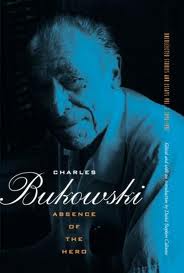
BOOK REVIEW: Charles Bukowski ABSENCE OF THE HERO: Uncollected Stories and Essays, Volume 2: 1946-1992. City Lights: San Francisco, 2010.


This volume of uncollected Bukowski stories and essays is not as substantial as Volume 1: Portions From a Wine-Stained Notebook (2008) but full of gold for the Bukowski reader. David Calone’s introductory essay is erudite and demonstrates the serious tone in which Bukowski studies are now conducted. Calone provides a clear, concise overview of the context and personalities that Bukowski wrote about in many of the stories and articles which appear in this volume. He also reveals Bukowski’s deep links with the Beat writers and provides shrewd insights into the development of his writing style.

About a third of Absence of the Hero consists of reviews of books by Allen Ginsberg, Louis Zukofsky, essays on d.a. levy, Harry Norse, peace, the state of American poetry and reprints from his L.A. Free Press column Notes Of A Dirty Old Man. Probably the most appealing to me of his non-fiction writings, include ‘Manifesto: A Call For Our Own Critics’- an appeal to small press writers to develop their own language of criticism and ‘Bukowski On Bukowski’ in which he favourably reviews Notes of a Dirty Old Man (1969): ‘Frankly I read my own stories in easy wonderment, forgetting who I was, almost almost, and I thought: Ummm, ummm, this son of a bitch can really write.’ In contrast, he says of reading his poetry, ‘Once I have written a poem and go back to it, I only get the sense of vomit and waste.’

Far more interesting are Bukowski’s short stories, particularly the longer ones which characteristically begin simply but branch out like cancers into other sub-strands of stories with unpredictable abandon and mayhem. The best short stories often fictionalise Bukowski’s life as a writer in his early 50s and include ‘East Hollywood: The New Paris’, ‘Vern’s Wife’, ‘The Gambler’, ‘The Cat In the Closet’, ‘The Ladies Man of East Hollywood’ and ‘The Big Dope Reading.’. The best short story in the collection is clearly ‘I Just Write Poetry So I Can Go To Bed With Girls’ which provides a deranged but affectionate portrait of Gregory Corso.

City Lights take their Bukowski uncollected stories and essays seriously and David Calonne has meticulously assembled and documented the two volumes of this series. Unlike a lot of the posthumous ECCO publications, this is essential reading for every Bukophile. 


See also my short review of Portions From a Wine-Stained Notebook here: http://georgedanderson.blogspot.com.au/2011/11/charles-bukowski-portions-from-wine.html


Wednesday, November 9, 2011

Charles Bukowski. New Book: PORTIONS FROM A WINE-STAINED NOTEBOOK: Uncollected Stories and Essays, 1944-1990. City Lights, San Francisco, 2008. (255 pages)


After struggling through many posthumous ECCO publications, I found this recent City Lights book refreshing and highly rewarding. It features a wealth of previously uncollected Bukowski material, including his first published short stories, book reviews, essays on literature, U.S. politics, his writing craft, biographical accounts, entries from his famous NOTES of a DIRTY OLD MAN newspaper column, tips on how to win at the racetrack and even a review of a Rolling Stones concert. David Stephen Calonne provides a lucid and highly learned introduction to the book.

I found most interesting his essays which are written in an innovative and typically no bullshit Bukowski style. ‘In Defense of a Certain Type of Poetry, A Certain Type of Life, A Certain Type of Blood-Filled Creature Who Will Someday Die’ (1966) clearly provides a manifesto for his poetics. Also memorable are ‘The L.A. Scene’ (1972) in which he provides a satirical take on the L.A. poetry scene and ‘Should We Burn Uncle Sam’s Ass’ (1970) in which he justifies his pacifist/ apolitical stance during the Vietnam War.

Also highly engaging are some of Bukowski’s uncollected short stories- the best being ‘The Night Nobody Believed I Was Allen Ginsberg’ a sprawling, mad narrative, ‘Workout’ (Hustler, 1977), a shrewdly observed story of an ugly old man entering the lives of beautiful young women and 'Distractions in the Literary Life' (High Times, 1984), a hilarious meta-fictional story which morphs from one moment of insanity to the next.

Bukowski’s voice comes across loud and clear. It helps the reader fill in some more of the gaps on where he is coming from. No Bukophile should miss out on this book. Buy it here: http://www.citylights.com/book/?GCOI=87286100856720

Absence of the Hero: Uncollected Stories and Essays, Volume Two: 1946-1992 is also available thru City Lights: http://www.citylights.com/book/?GCOI=87286100446250