recent posts

Showing posts with label Holy & Intoxicated Publications: John D Robinson. Show all posts

Tuesday, February 22, 2022

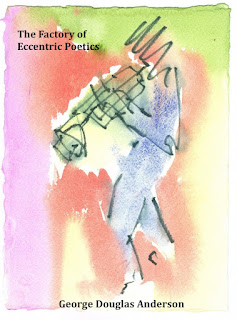
New Release: George Douglas Anderson THE FACTORY OF ECCENTRIC POETICS (Holy & Intoxicated Publications, 2021) 20 pages


In this new chapbook, Anderson veers away from his usual narratives & portraits. The poetry here is more abstract. It includes many found and cut & paste poems, sometimes influenced by his students. The front cover is beautifully illustrated by the Swedish writer and artist Henry Denander. 


Find Jason Gerrish’s recent interview about the chap here: 


https://georgedanderson.blogspot.com/2022/01/jason-garish-interviews-george-douglas.html


A couple of blurbs about the chapbook:


 The Factory of Eccentric Poetics

George Douglas Anderson


Poets, are mostly cowardly, that is, once a poet hits on a form/style to comfortably put their words across, they dig a hole and jump into it: (myself included) it feels safe and secure.


George Douglas Anderson digs tunnels and you never know where the tunnels will be taking you, until you are there: as a Small Press Publisher, when I request and receive a manuscript from George, I know one thing for certain, it will be quality: ‘The Factory of Eccentric Poetics’ is exactly that: from the hazy, ghostly cover art work from the ever brilliant Henry Denander, depicting a trumpet playing jazz musician, drowning in a flush and array of uplifting colours, to the final poem, ‘The Thing Itself’, the reader is easily, smoothly locked into the rhythm of the book, as the poems lunge and plunge like the soulful breath of Chet Baker or glide silk-like, like a haunting Miles Davis solo: the time signatures roam freely, without hesitation: passion and compassion drives this book: ‘The Parched Grass’ ‘Danger Falling Man’ ‘His Brain is a Fish’ ‘The Cult of the Amateur’ ‘Skinned’ to name a few, are simply, strangely enchanting and captivating.


Dig ‘The Factory of Eccentric Poetics’: dig the works of George Douglas Anderson:


John D Robinson

Poet and Publisher.


The Factory Of Eccentric Poeticsis the latest chapbook by author George Douglas Anderson. In this collection of eighteen new and abstract poems, Anderson explores a new poetic voice, veering from the authorial and objective narrative style he established in earlier chaps and in his full-length book of poems: The Rough End Of The Pineapple.In his own words, Anderson says,“The chapbook is an attempt to affirm but also to subvert post-modern ways of thinking…”.


The poem A Bee Collecting Honey is a sequence of engaging images, which defy a linear interpretation. It is the first poem in the collection that had me consider: Can a poem be a collage? 


Anderson says, of A Bee Collecting Honey,“The chronology of the poem’s narrative is deliberately thrown into disarray and instead is revealed in fragments. It uses compressed images and associations to reveal a woman’s tormented life which has been tragically cut short.”


Several poems in this collection read like a collage; and if a poem can be described as a crazy quilt, it is Anderson’s poem Skinned, which he says of the title, “…refers to a recent trend to cut out the full back tattoo panels of heavily tattooed corpses and to preserve them as Art.”


The images in this piece engage me so successfully, I become hell bent on interpreting them collectively, but Skinned defies a linear interpretation. I feel the poem calls for an escape from the material world, for a spiritual release. Anderson says of the poem“…I perhaps imagined the words, like the deceased’s tattooed skin expressing a montage of feelings and experiences.”


The risks Anderson takes cutting from usual narrative style, make The Factory Of Eccentric Poetics a rewarding read. They are a postmodern patchwork that reveal a diversity of spirit and a troubled world of tortured souls.


Jason Garish


Limited edition: 25 signed and numbered. Only 5 left to dispatch.


 Buy the book here direct through PayPal: georgedanderson8@gmail.com for $5 AUD  plus postage.


Postage: Australia wide: $2.20

                USA / Europe: $14.60 (I'll throw in another chap)

Sunday, January 23, 2022

Jason Gerrish Interviews George Douglas Anderson about his new chapbook The Factory of Eccentric Poetics (Holy & Intoxicated Publications, 2022)


The speaker in this chapbook seems to have a deeper understanding of time and space than the narrator in your collection The Rough End Of The Pineapple.  The speaker also plays a less central role in these poems and appears to be outside the poem and looking in, at events. Can you discuss your treatment of time and space in this collection?


Many of the poems in the chapbook in the collection were written well before the publication of The Rough End of the Pineapple. At the time, I was dabbling with post-modern theories of deconstruction in my Preliminary & HSC classes whilst studying films such as The MatrixBlade Runner, the revisionist Clint Eastwood Western Unforgiven and Michael Ondaatje's amazing first novel The Collected Works of Billy The Kid.  


There is no common speaker in the chap. Each poem is unique and the poems tend to deliberately blur the specifics of time & space. The chap features what I call my “abstract” poems.


The poems were initially written as experiments in form & style without publication in mind. The chapbook is an attempt to affirm but also to subvert post-modern ways of thinking. I'm not blindly bowing down to po-mo and sometimes try to playfully kick it up the ass. 


This is perhaps best represented in the following poem: 


Running Away With the Spoon


amongst the electric cacophony of memory

the sobbing knife plunges in & out

time as an uneven continuum;

Foucault behind us retching loudly


The elephant in the room

her pink diamante decorated pager

a series of displaced recollections; 

a face resembling an overcooked cabbage


Her hips dizzy, whispering

in constant flux. A chance comfort 

in a squalid, idiom filled illeism

like a mad dog to its faeces


The first poem I wrote in this style was aptly titled ‘Centos’ (2008): http://www.poetrycemetery.com/andersonnew.htm


In The Rough End of the Pineapple you will also find some examples of my abstract work, such as ‘On Obscurity’ and ‘Diary of a Semi-Colon’. More recently, I was encouraged by Henry Stanton of The Raw Art Review who ran with three poems from the chap in late 2020.  


I also hugely salute my publisher John D. Robinson of Holy & Intoxicated Publications who accepted this experimental chap without any bullshit or requests for revision. Robinson has now published three of my chapbooks Fuckwits & Angels (2019), The Portal (2020) and The Factory of Eccentric Poetics (2022). The hugely talented Englishman has had an amazing writing career trajectory of his own but has also published small alternative press poetry heroes such as Doug Draime & A.D. Winans and as nurtured and encouraged many other writers- including myself.   


I want to jump right to one of your abstract poems, because you take some exciting risks in this collection. The poem ‘Danger Falling Man’ is a short piece, but I feel time and space have been opened up and expanded in this short poem, to include the weight of the protagonist’s entire life. What were your challenges in writing this poem?


The main challenge, as with most poems in the chap, is to try to shift from my usual clear, narrative style while still retaining a sense of coherency and order. I also didn’t want the poems to come across as too contrived, as intellectual bullshit. Poems in this style open themselves up to the criticism that they are wanky literary exercises which foreground form over substance. Ever try reading AMERICAN HYBRID: A Norton Anthology of NewPoetry (2009)? It's total crap!


A couple of days ago in response to your question, I opened my workbooks for the first time since the conception of the poem. As you know, I prefer my poems to speak for themselves, but as a high school teacher over decades, I also like to explain things in detail, including the dull, unimportant aspects of my writing.


Most of the words in 'Danger Falling Man' were lifted from my HSC Extension 2 students who were creating material for their Major Work short stories:   https://educationstandards.nsw.edu.au/wps/portal/nesa/11-12/stage-6-learning-areas/stage-6-english/english-extension-2017/major-work-advice


While examining their work, I compiled a list of some of their oddly memorable lines. I later reshuffled the lines and broke the writing into stanzas to create new and absurd meanings.


Notes for 'Danger Falling Man' (click to enlarge)

 I was intrigued how some filmmakers, writers and musicians used an eclectic mix of different styles and source materials to create something entirely new. ‘Danger Falling Man’ is a “found” poem which uses a cut & paste style. The speaker uses multiple voices and ironically, I reckon is in serious danger of "falling" short artistically in the mongrel pastiche creation of the poem.


Another abstract poem is ‘A Bee Collecting Honey’. I am deeply concerned by the urgency in each troubled line of ‘A Bee Collecting Honey’. I am attracted to each image in this poem and yet I have failed to understand or experience the poem, as a whole. What can you tell me about the subject of this poem and its title?


The chronology of the poem’s narrative is deliberately thrown into disarray and instead is revealed in fragments. It uses compressed images and associations to reveal a woman’s tormented life which has been tragically cut short. This idea is sharply contrasted with the serene, natural image of a bee collecting honey in a field:


 A Bee Collecting Honey


her skeletal body

his own filled with hollowed hope


the red claret-stained concrete reeking of loss

the wild tattoo of her life robbed by stealth


disappointment was a polished slab

beneath her thin-mattressed soul


hooks tearing at the innards of her throat

he is a missile spiraling out of control at 25 metres per second  


a streak of blue & red for a face

a freshly cut lawn seeping from pall-bearing lips


she kneels convulsing in the mud beside the limp boy

bags of sand hunched tight under the sagging sun


There are several poems in this collection that refuse to be easily defined. ‘Skinned’ is another poem that, like ‘A Bee Collecting Honey’, resists a linear interpretation. I struggled with ‘Skinned’to experience it chronologically, but I couldn’t bend it into something straight. I experience “Skinned” as a dream.


The poem ‘Skinned’ is one of my earliest “abstract” poems. I like the way it defies definition & how it really doesn’t make much sense if you examine it closely. This is in sharp contrast to my over-rational day job over decades as a high school teacher in an elite institution. 


I cannot recall the specific context of the poem and why it was written, apart from it being an experiment. In my notes to the poem the term “skinned” refers to a recent trend to cut out the full back tattoo panels of heavily tattooed corpses and to preserve them as Art.  


In the poem, I perhaps imagined the words, like the deceased’s tattooed skin expressing a montage of feelings and experiences.


Find the poem ‘Skinned’ online here: http://clockwisecat.blogspot.com/2011/01/skinned-by-george-anderson.html


I like the term “compressed images” you used, like forcing air into a balloon, until it can’t take anymore, just before it pops. It describes how engaging the images in these poems are for me. Who are some of your influences for found and cut and paste poetry?


I was looking for new forms to express my poetry and for my students to submit to the school’s long-standing poetry journal Ephemeral. There is plenty of material online.


As far as “non-lineal” texts are concerned, I found useful John Ashbery April Galleons, Michael Brennan Autoethnographic and Michael Farrell ode ode- the latter whom I met in Sydney while a member of the Poet's Union. More recently, a poet friend gave me a heads-up to an article 'William Burroughs: The Cut Up Method' which might interest you: https://www.writing.upenn.edu/~afilreis/88v/burroughs-cutup.html


How many of the poems in The Factory of Eccentric Poetics are, in part, made up of the many voices you have heard and read from your students over the years?


In the collection the purely “found poems” would include my favourite ‘Moth’, ‘A History of Lies’, ‘His Brain is a Fish’ and a few others. As I mentioned previously, they were written as experiments to contrast with my characteristic, more accessible work. 


I’m imagining that some of the lines in these poems remind you of students you have taught. Is there an echo, for you, of your classroom, layered in the “found” or “cut and paste” poems that you have mentioned?


Interesting question. I have dealt with the concept of students in my classroom being layered in my imagination in my chapbook of school poems ‘The Portal’ (Holy & Intoxicated Publications, 2020). 


The found poems are usually lines taken from numerous unidentified students and therefore I am unable to link specific lines to specific students. Perhaps the best thing I got out of the process was to turn the arduous task of grading students into a creative event. 


In the title poem, ‘The Factory of Eccentric Poetics’, I feel you are describing a very raw creative process that surrenders to chaos or madness. However, it interests me that the poem itself has melodious language and meter. What can you tell me about your intent for this poem and your choice of meter and language?


Today, I found my notes on the poem for the first time since writing it. I borrowed & heavily edited a student's short stories written for exam purposes. I discarded about half of the found lines, shuffled them beyond recognition & added a few words here & there:


The Factory of Eccentric Poetics


in the underworld of his mind

it was madness, it was madness


the flecking monochromic images

the pastiche, tedium of sentences


dancing towards an endless nothing

trading notes, rhythms & off-beats


dissonant/ out of tune as though

several songs were ushering at once


sledge-hammering out of their imprisoned cadence


The title is of my own invention and I surmise it derives from the description of the trumpet player near the end of the poem attempting to rise above “the tedium of sentences" and after many failed experiments finds his voice- "sledge-hammering out of their imprisoned structure.” 


Henry Denander’s cover beautifully illustrates this artistic quest.


I love the line “sledge-hammering out of their imprisoned structure”, and I think The Factory of Eccentric Poetics is great title for this book. How did you go about selecting the poems for this chap?  


First, I listed the poems which I labeled abstract, perhaps about 50. Then I culled the mongrels in terms of merit- language, sound, idea, coherence. Later, I intuitively sequenced them. The whole process took at least two months. 


Another poem that moves me in this collection is ‘The God Of Doors’. I have a strong emotional response with this piece and keep coming back to it. What can you tell me about this poem?


The poem is another one of my digs at suits, the establishment, which views the economy as supremely important- far more important than other matters like our health. It uses images from cinema-photography to show the failings of government & business, particularly when viewed in terms of our present crisis.  


 The God of Doors


like a darkly bruised banana

I miss the flesh of her pale lips


I miss the depth of field 

of her spider-bite piercings


I miss her tight aperture,

her perfectly sculptured combover


instead- the self-satisfied swagger

of bewildered suits


towards goals as purposeless

as birds without wings


the diamond necklaces of short-sightedness


Where is the chapbook available for purchase, and what’s next for you, George?


Just received my shipment and there are about 5 copies still available for $5 each plus postage (from Australia). 


Next for me? I’m presently working on a chapbook for Between Shadows Press called ‘The Beast With 3 Legs.’ Cover art by Danny D. Ford. I return to my clear narrative poems which are character driven.


Thank you, George, for taking the time to speak with me about your new chapbook.  

Thanks again, Jason for taking the time to carefully read my work!

Wednesday, May 13, 2020

Featuring George Douglas Anderson


I have edited Bold Monkey for over ten years. I like to use this electronic space to promote the writings of the alternative small press. Sometimes I feel an urge to add to the pile.

I grew up below the tracks in NDG in Montreal and moved to New Zealand and then to Australia in my early 20s.

My main spark in writing poetry was ignited in 2000 when a close friend of mine died of throat cancer. As his corpse edged its way towards the curtains of the crematorium I reckoned I needed to get some of my shit down.

A few days later,  I was in a hall supervising a Year 12 exam. The words just flew out of me and I wrote them down on a spare pad of paper in the back of the hall. The poem 'The Portal' will shortly be included in a chapbook of my school poems of the same name and published by poet & editor John D. Robinson of Holy & Intoxicated Press. Click on any image below to enlarge.


Here  is a brief sampling of some of my work and where you may find it:


A Beginner’s Guide To Death

My mother died
one late November afternoon


my young sisters found her
on their bottom bunk bed
with pissed pants.

Returning from my paper route
I slide through the back door
& I was surprised to see Mr White

the old man
my brothers & sisters
heads bowed as if in prayer.


A few days later
my mother lay deep in the womb

of the funeral home
on Sherbrooke Street
her cheeks
tinted with rouge make-up
like a whore.


My father was so distraught
he left the funeral arrangements
to others
the service hi-jacked by Christians

punctuated by the rallying cry
of centuries old, out-of-tune hymns
 
& the uttering of hollow prayers.

The old man sat directly 
behind me during the service 
& from time to time
he would edge closer
& whisper into my ear
in a deep growl
that I alone could hear:


‘Bullshit. 
Fucking bullshit.’

(Nominated for a Pushcart Prize in 2019)


From the chapbook FUCKWITS & ANGELS (Holy & Intoxicated Publications, UK 2019). SOLD OUT. 'The Burial' first appeared in The Bones of Nirvana, Svensk Apache, 2016. Illustration by the Swedish artist Janne Karlsson.


KEITH

Keith is a regular who usually shows up at three in the afternoon for his “daily constitution”- a pint of Dark Ale. He always wears a sharp suit and his shoes are immaculately cleaned and polished. He is a World War 2 veteran who fought in Tobruk against Rommel, but like most veterans, he never talks about his experiences. His secrets are buried deep within him. 

One day, we get around to talking about shoes. I tell Keith I recently purchased a pair of shoes on the internet. A friend was getting married in Leichhardt and I was best man. He perks up.

“Oh, what size do you wear?”

“Twelve. Why do you ask?”

“I thought so. I’ve got just the pair for you.”

“Don’t worry Keith, I’ve already got a pair.”

“Nonsense.”

The next day Keith enters the bar and hands me a beautifully polished pair of black shoes. 

“Try this lot on,” he says.

I’m impressed. I slip them on.

“They fit perfectly. They’re wonderful, where did you get them?”

“Oh, they were home collecting dust. You must have them.”

“Keith, they are so shinny I can actually see my face in them.”

“Young people don’t put in the effort these days,” he says.

Keith reaches in his bag and pulls out a can of black shoe polish and a clean rag.

“Here, have these as well. The secret is in the muscle you put behind it, and in this,” as he lands a large gob of spit on the toe of the shoe.

I laugh in admiration.

“Thanks Keith, where’d you learn how to do that?”

“Early on at Tobruk, sometimes we spent four hours a days cleaning our boots. It gave us something to do as we were preparing to take on the Krauts.”

From my short story collection The Empty Glass. There is some heavy, confronting shit about alcoholism & Australia's drinking culture in the book, so it's not for everyone: https://georgedanderson.blogspot.com/2020/02/new-release-george-anderson-empty-glass.html


Elvis on the Factory Floor

For a time I worked 
in a factory
slipping tiny plastic sleeves 
onto the gold wings
of ski bindings

then cooking the plastic
on a slow moving conveyor belt
under a hot lamp
until the plastic molded to the steel
& then plopped 
into a box.

One summer’s day 
as the steel presses boomed
& the rivet guns clanked,
I heard on the radio 
that the King
had died.  
Heart attack. 
Aged 42. 

White wings 
every five 
seconds 
free-falling

into that 
greasy 
cardboard 
box.

From my chapbook Teaching My Computer Irony (Epic Rites Press- Punk Chapbook Series 2, 2016).

Auntie Via


Most Wednesdays
I visit my Auntie Via
with my mom at Peria House-
she’s nearly 85 years old

She has a glass eye
it sits there  staring at you
with a blue icy blankness

Last week- my mom was talking to her
about her brother & the weather-
she was propped up in bed
& struggling to recall my face
when suddenly her eye popped out
& rolled down her pyjamas
& into the folds of her bed

She sat there
blissfully unaware
of that sunken hole amongst
the bones in her face-
two nurses laughed as they 
    scrambled to pull the bed apart,
searching for that elusive eye

I watch fascinated 
as her glass eye 
                       bounces-
                                     onto the
                                                floor-
                                                                & rolls under her commode

After a quick clean
her eye is popped back 
         into      place
& Auntie Via is harnessed tightly
into her side chair

I closely scrutinise her,
trying to recall
which one is real-
her two eyes like 
blank slits in the 
early evening’s funereal light

From the children's chapbook Melting Voices (Perspicacious Press, 2011). The poem was originally published in The School Magazine (2010):


Melting Voices was a chapbook of poems used for classroom purposes and is not available online.

Doonside

You make an impromptu entrance into my life
kicking open with considerable skill the shed door
housing heavily chained bikes & grass cutting equipment-
Leo, our enigmatic Chow sends you away; for now

the following evening you reappear
a blackened, indecipherable shape through a small square front entry window
I voyeurishly watch you bending over 30 metres away
examining     perhaps admiring in a humoured, knowing manner
the challenge of our new fish hook dead lock

barefooted-
with a Bob Bailey autographed baseball bat in hand
I CHARGE flat-out        silently         towards you
murderously-  I know fully
I’m going to SMASH YOUR FACE IN
when I catch you

you are elusive-
you down the tools of your trade
& sprint headlong to the front fence
& fling yourself precariously
carelessly
over the 2 metre metal fence
the dog now awake to its task                    
chasing you, us

leaping the fence in one wild bound     
I pursue you 
down the blue metal street                                                              
you disappearing 
through a conveniently cut wire fence     
into the disused brickworks
I shout out menacingly to you:
I’LL KILL YEAH!! (& really mean it)
& thrash the air several times with the baseball bat for effect

The police arrive the next day
& tell me he could have had a knife
& slashed my face or torso
entering it deep & cold
me lying wounded   oozing
like a slashed waterbed
or the shit smeared walls
they've often left behind

From my first chapbook Dancing on Thin Ice (erbacce-press 2008): http://erbacce-press.webeden.co.uk/george-anderson/4529601467


Also keep an eye out for my full-length collection of portrait poems The Rough End of the Pineapple (Uncollected Press, 2020): 


Chopper


On the North Mountain his incinerated Harley

leans against a spruce tree close to his red cedar cabin


ten years after the event a charred monument to an

unpredictable speed wobble throttling up Aylesford Road


at 130 the handle bars wildly flopping, the decision to fling

his bike forwards, to leap off the bike backwards in the dark


his wistful attempt to cradle his hands together/back straight & then to slide like a lit missile along the rough asphalt road- 


without leathers- his skin peeling off in strips- until hitting a bump & then sent screaming into a ditch, rolling into barbed 


wire; knocked unconscious. Of the searing, mind needling pain/his back & legs and ass ground into the pavement &


blackened like overcooked beef.


From The Rough End of the Pineapple. Available through Uncollected Press here: https://therawartreview.com/2020/07/16/book-published-the-rough-end-of-the-pineapple-by-george-douglas-anderson/

Note: A sharp bikie, remarked that the incinerated bike above is not a Harley but a Yamaha V-Max. He's correct. Harley just sounds better!

Update: 14 January 2022

New book soon to be released by Holy & Intoxicated Publications. Terrific cover by Henry Denander: