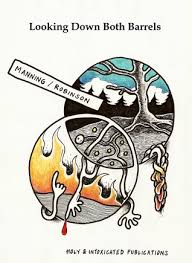
In Adrian Manning’s latest book Digging Up The Bones he collects for the first time poems from his 18 previously published chapbooks and also includes in the last section eight of his uncollected poems, he refers to as his ‘Scattered Remains’. In total there are 84 poems in the collection which were written between 1997 and 2019. The poems initially appeared in prestigious small alternative publications such as Kendra Steiner Editions, Bottle of Smoke Press, Holy & Intoxicated Publications and other fine places; including Manning’s micropress Concrete Meat Press: https://adrianmanning.wixsite.com/concretemeatpress
In the extended interview which follows this review, Manning outlines the overall intention and process of putting together Digging Up The Bones. “I have had poems published in magazines and chapbooks for 20 plus years and I felt this was a good time to select a collection of what I considered some of my best poems to mark this stage of my writing life! I did want to include some work from each chapbook. I liked the idea of a timeline from the beginning to the present. I looked back at each one and selected the poems that I thought were the best ones and in some cases where there had been particular positive responses from people who had read them the first time… Choosing from each chapbook also allowed the opportunity to include poems of different styles, for example sections from longer pieces such as Wide Asleep, Fast Awake or more experimental collections such as 13 Poems from the Edge of Extinction. Upon reviewing the poems, I found some that never got collected in chapbooks that I thought I would like to include and a small selection of these are included at the end of the book.”
Manning’s collection certainly is diverse and showcases a wide variety of subject matter, styles and themes over two decades. The writing is tight, carefully crafted and typically free verse in form and from a variety of points of view.
As Manning noted above, the poems appear in the chronological order in which they were first published in chapbook form. Some of the early poems, such as, ‘The Poet in His Underwear’, ‘The First Poem’, ‘Blood, He Said’, ‘Move’, ‘Religion’ and others adopt the imagery and form of the American writer Charles Bukowski, but as Manning’s work has grown, he has developed a strikingly original voice of his own.
In the interview below, Manning candidly comments in detail on the impact Bukowski’s writing has had on his work. “I know people are often disparaging of people who name Bukowski as an influence but he really was. Everyone has their opinions on him. I think his influence shows in some of my poems - for better or worse- and presenting the poems in this book in chronological published order may show that particularly in earlier works as I was trying to find a voice of my own. He still influences me now, but as I have discovered a raft of other poets, some old, some young, some dead, some alive, I have absorbed many other influences that do make me consider my own writing in different ways. I would hope after all this time that I have my own style, but I am always learning and being inspired whether it's by an older poet or a twenty something publishing their first chapbook!”
Asked how his poetry has evolved over the last twenty years or so, Manning says, “I look at things with a wider range of experience and different thoughts now so I hope that gets reflected too. Over the years I have used a greater amount of brevity in many cases - say more with less and I have become more abstract and experimental at different times in some of the work. Having said that though, there is occasionally still the straight prose poem approach that never seems to go away.”
Some of the chapbooks are arranged with a specific unifying theme in mind while others simply collect the best of Manning’s work which had recently been published. He says regarding this, “Some are a collection of poems that have been published in small magazines, on the internet and broadsides plus some unpublished ones. Sometimes I get a theme and work with that. Wide Asleep, Fast Awake, These Hands of Mine, Dreams From Under a Rock and Savage Beast are examples of this. 13 Poems From the Edge of Extinction was a collection of surreal poem ideas that came together quickly and were written together.”
Despite the fragmented, “best of” structure of Digging Up The Bones what gives the book unity and strength is Manning’s intricate use of motif. Although his work has evolved towards increased brevity and experimentation over the years, he seeds his poems with reoccurring ideas, which when considered collectively, add to the complexity and enjoyment of his work. Motifs include the interplay between light and dark, hands, time, ghosts, death, dreams, luck, cats and others.
Most fascinating to me is how Manning incorporates the subtle theme of “words” in his work, particularly how it transitions from the notion of the power of words, and as his work develops, to his growing impatience with language and the increasing difficulty in capturing the nature of reality through their use.
In ‘Waking to Sleep’, for example, the speaker, presumably Manning, concludes the poem realising that language is an artifice, “All words are lies.” Similarly in ‘Days Like This’, the speaker’s senses appear to have overwhelmed him and he desires silence, “blank pages”:
I want music without sound
A book with blank pages
And art with no shape
Line or colour
The poem ‘People in the Sun’ from Bring Down The Sun (Art Bureau Press, 2005) demonstrates further a tendency in Manning's art towards fragmentation and abstraction. Words are seen not as liberating but rather as a means to escape life’s harsh and empty realities:
People in the Sun
The mountains, precise and ashen
lay like a sheet draped over lifeless bodies.
Flames of corn lick the sky.
Strapped into folding chairs,
leaning back into it, like astronauts
at the first stages of propulsion,
uninhabited, motionless
bodies stare blankly at the cloudless blue.
Caressed by the heat, they bask,
Eyes open but seeing nothing,
Not a speck on the horizon.
Alone they face the truth of emptiness.
Only a solitary mortal, behind them,
Ignores the cacophony of this existence,
Escaping to the hiding places between
the words found on the page of a book.
(All poems in this review are posted with the permission of the poet)
The title of the collection Digging Up The Bones is an obvious reference to Manning revisiting the poems of his past. He says of the title, “I saw the poems as being the bones that had been buried over the years in small magazines and chapbooks and as they resurfaced for this collection the title seemed to fit.”
The front cover is by Hank Stanton, the editor and publisher of Uncollected Press: https://therawartreview.com It is an impressionistic drawing of a road, perhaps of a cemetery at night. Manning says of Stanton’s involvement in the project, “I had been very impressed by Hank's publications that I had seen. I sent him a mail asking him if he would be interested in seeing the manuscript. He immediately said yes and once he saw it he was very enthusiastic which was amazing. He has obviously created the book itself and produced a beautiful picture which graces the front cover. He discussed the elements with me, cover, foreword, photo etc as you would expect. He has been an example of a fantastic editor who will put his faith in the poet, the poems and respect their work and I cannot thank him enough.”
You will also find in the collection several poems about writers and the writing of poetry. Most interesting amongst these include Manning’s first published poem aptly called ‘The First Poem’, ‘Bring Me’ about the importance of a muse, ‘And Fahrenheit 451 Evens the Score’ that “if you’re gonna/ write a poem/ write words/ that will burn” and ‘December 1st1966’ a narrative poem about the police raid on Jim Lowell’s Asphodel’s Bookshop in Cleveland in which they arrested Lowell and d.a.levy on obscenity charges, which were later dropped.
Perhaps even more notable amongst these metapoems are ‘This is Not a Poem’ in which Manning describes his conception of what a poem is. He sees it as being more than “a gathering of words”, rather more as an emerging inarticulate self, a shaping of experience independent of readership:
the real poems are under rocks
buried in the ground
in cemeteries, alleyways and bars
the real poems are laid up in hospitals
begging on street corners
marching on financial institutions
and banging on government doors
they are in taxi cabs, factories
and prisoners awaiting sentence
the real poems are screaming
from beyond the page
making a din
proudly and without fear of
false critics
More playful and cheeky is ‘Literary Gunslinger’ which uses an extended metaphor to represent the writer as a Western gunman who needs to use his wit and improvisational skills in order to survive and triumph. His weapons are his “blazing words”, his ability to fire off “some heavy duty stanzas” or “agile acrobatic alliteration maybe”:
Literary Gunslinger
to walk into the centre of town – boots crunching dirt
fingers toying with paper scraps rolled up barrel – like
in pockets – make shift holsters ready for trouble
a literary gunslinger armed to the teeth with words
I’d wait for the meanest of the bunch
to come up for air then whip out a poem
fire off a couple of rounds – some heavy duty stanzas
watch him fall to his knees surprised and in shock
then finish him off mercifully with some fancy stuff
agile acrobatic alliteration maybe
blowing the smoke away from the blazing words
I’d wait for the admiration from the children and women
rattle them with some similes – as quick as sudden light
a few metaphors – my words torches on fire
to make them wow and swoon
then impress them with my onomatopoeia – THUD!
I’d walk out of town leaving a broadside calling card
stopping only to watch as the sheriff begins to mount
wanted posters naming me and some of the others
stating the price – dead or alive
but smiling to myself as I pull the brim of my hat
over my eyes glistening with good humour
and knowing that whatever happens to us
the ones that have hit have already left their mark
Asked about his secret in getting his words to come alive onto the page, Manning is enigmatic like most writers, “I just let the words come. I don't sit and try to write a poem. Usually a line or an idea will come to me and the words will roll around in my head for a while then I will start a poem. I try to get it written as quickly as I can! The middle of the night, in the half-light between waking and sleeping, poems come - words or lines. Then the chase is on. Seeing something, hearing something, reading something, just thinking - words, ideas will come.”
The work which strikes me as perhaps the most imaginative and most fully rounded in Manning’s portfolio are his poems which focus on his relationship with women.
Manning says of this general observation, “I have always tried to do that in my poetry. Its okay reading a personal poem but I believe it has to written in a way that can touch others and provoke their own thoughts and reflections. That's the essence of poetry to me. I don't think I have made a conscious effort to do that with regard to only the poems about relationships with women in my life… I try to bring out the emotions and mental working within relationships and their ups and downs whatever the relationship of the woman concerned and myself is.”
Manning tends to avoid the usual clichés about love and creates striking metaphors and images to convey his ideas and emotions. Significant amongst these poems are ‘Sorrow’, ‘Today – Everyday’, ‘For She Who is Not There’ about the search for the ideal partner, ‘The Edge of the World’ about physical love and ‘Sunlight in Motion’ about how his lover “can kick away” the darkness.
One of my favourite poems in the collection is the following which poignantly strips back a couple’s relationship to reveal the inexplicable but inevitable falling out of love:
It Has Been and Gone and is Hard to Recall
each night she brings the dark
unforgiving evening to a close
goes to the bedroom and waits
he sits in the other room
tv on at low volume
or sitting in silence
a small lamp burning
across the page of a book
she is waiting for love
a love which never arrives
it lies in the hallway
like a dead kitten
doors shut on either side
the mystery was solved
many years ago
when they were young and knew
little about each other
without mystery there is
no need for a solution
when he comes he will be thinking
of a young girl red hair on flame
a coiled body sprung like a cobra
she will be lost in sleep
dreaming of a young man
a young actor or athlete
they sleep slightly apart
separated by wet fish
only touching by accident
through the dark wilderness
of a world that has been cheated
them
both
As an end note, Manning also tries to tackle in his poetry some of the political issues which affect our planet. There is a growing concern in his work about the coming apocalypse as in his chapbook 13 Poems From The Edge of Extinction (Crisis Chronicles Press, 2017). His poems ‘Becoming Clear’, ‘Dark Surrender’, ‘This is the Last Night on Earth’, ‘What we can Ignore from Thousands of Miles Away’ are all dark, foreboding tomes of doom.
Asked whether he is optimistic about the future in view of the political class’s inability to accept climate change, he says, “I generally hold onto hope for humanity but as I get older it sometimes becomes more difficult. As we all do, I'm sure, we meet people who are amazing humans, the best around us and we see incredible things being done but there are times when it seems pretty desperate. I despair at times at the political decisions being made and in the current climate the way we are heading towards more insular and selfish behaviours as nations and individuals. I hope we are not doomed - I hope that we will see the errors of our ways - environmentally, politically and personally - to correct some of the follies of the past.”
The collection Digging Up The Bones represents an excellent distillation of Adrian Manning’s poetry to date. These are serious, deep and thoughtfully constructed poems. Although only a small sampling of his work, it is fascinating to read about his struggles with existence and to follow his progression as an artist.

INTERVIEW WITH ADRIAN MANNING: 27 January 2020
The book features poems from 18 of your previously published chapbooks as well as some uncollected poems. What were the events that lead you to put together your selected book of poems “Digging Up The Bones”?
I have had poems published in magazines and chapbooks for 20 plus years and I felt this was a good time to select a collection of what I considered some of my bet poems to mark this stage of my writing life! Also, as a number of these chapbooks and magazines were limited in number and distribution over the years, I wanted to offer newer readers a chance to read some of the earlier work.
What was the process behind the scenes in selecting the poems for this collection?
I did want to include some work from each chapbook. I liked the idea of a timeline from the beginning to the present. I looked back at each one and selected the poems that I thought were the best ones and in some cases where there had been particular positive responses from people who had read them the first time. Choosing from each chapbook also allowed the opportunity to include poems of different styles, for example sections from longer pieces such as Wide Asleep, Fast Awake or more experimental collections such as 13 Poems from the Edge of Extinction. Upon reviewing the poems, I found some that never got collected in chapbooks that I thought I would like to include and a small selection of these are included at the end of the book. There are so many collected and uncollected poems that aren't included in the book.
When did you first develop an interest in writing poetry? Who were some of your early influences?
My first experiments in writing were as a pre-teen writing lyrics for imaginary songs or alternative lyrics based upon songs I liked! Music has always been a major love of mine. As a young adult I started to gather a collection of prose poems scribbled by hand in a notebook - trying to make sense of the world I lived in! I was influenced at this point by Jim Morrison of The Doors and Leonard Cohen in particular. The music led me to the poet. I then discovered Allan Ginsberg, Jack Kerouac and William S. Burroughs and started a life long love of the beats. At some point I discovered Charles Bukowski and that was it. I started to write more seriously in my early twenties - I even used a borrowed typewriter! I still have the collection of poems - I think one of them did eventually get published! I know people are often disparaging of people who name Bukowski as an influence but he really was. Everyone has their opinions on him. I think his influence shows in some of my poems - for better or worse- and presenting the poems in this book in chronological published order may show that particularly in earlier works as I was trying to find a voice of my own. He still influences me now, but as I have discovered a raft of other poets, some old, some young, some dead, some alive I have absorbed many other influences that do make me consider my own writing in different ways. I would hope after all this time that I have my own style, but I am always learning and being inspired whether it's by an older poet or a twenty something publishing their first chapbook!
How would you describe how your poetry has evolved over the last 20 years or so?
As I mentioned I initially started off under the influence of other poets that I enjoyed reading. I hope that my poetry has developed in a number of ways. Firstly, I am twenty years older so, although I write about similar themes, there is a different slant on the work as it has evolved - less obvious in many poems, subtler. I look at things with a wider range of experience and different thoughts now so I hope that gets reflected too. Over the years I have used a greater amount of brevity in many cases - say more with less and I have become more abstract and experimental at different times in some of the work. Having said that though, there is occasionally still the straight prose poem approach that never seems to go away.
Speaking of Bukowski, in ‘Religion’ the speaker, presumably yourself, scolds the fanatics who arrive at his door: ‘I am not interested/ I tell them I worship at the/ Church of Bukowski.” As you know, Buk these days is either revered or maligned. What is your overall assessment of his influence on contemporary poetry?
I am, and always will be, an enormous fan of Bukowski. I know he had his flaws as a human being - don't we all? He was more obvious than most and less concerned about how other people viewed him than many. So I get why people are sometimes not that happy about him. I think his influence on contemporary poetry is still very much alive and great. I read a lot of poems by a lot of poets and in these, I see the influence of the style, the content and the approach to poetry that I think was instigated by Bukowski's writing. Some sail very close to imitation. I have been accused of that myself in the past and to some degree, that may have been fair. I think if you have read a lot of Bukowski and write poems because of his influence there will be an element of that somewhere. I was once introduced at a local reading as "Leicester's Charles Bukowski". I was ok with that because of the influence and style, but I have long gone past thinking I could be like Bukowski. He was a one off in my opinion and I couldn't claim to live life like him in any way so the poetry and the lifestyle are separate. However, I am fascinated by people like Bukowski and I will always will be.
Do you usually create chapbooks with an unifying theme or do you write a batch of poems and then try to collect the best stuff independent of theme?
It varies. Some are a collection of poems that have been published in small magazines, on the internet and broadsides plus some unpublished ones. Sometimes I get a theme and work with that. Wide Asleep, Fast Awake, These Hands of Mine, Dreams From Under a Rock and Savage Beast are examples of this. 13 Poems From the Edge of Extinction was a collection of surreal poem ideas that came together quickly and were written together.
You have dealt with many editors over the years in the publication of your many chapbooks. What are some qualities of an excellent editor?
I am very grateful to the editors I have worked with. I note the main ones in the book with many thanks as they have all been amazing. First of all their dedication and enthusiasm for the work is important - their willingness to put out new work they like without worrying if it will sell massive numbers and their commitment to getting the poems out there. Most editors have gone with the work I have presented to them in the way it is presented which shows trust and faith which I highly value. Where suggestions have been made, they have usually been pretty spot on, so a good editor knows when to do this. Overall they have always put so much time and talent into producing amazing publications with great cover art and something I am very proud to be involved in.
Turning one again to Digging Up The Bones what was Hank Stanton’s involvement in the project?
I had been very impressed by Hank's publications that I had seen. I sent him a mail asking him if he would be interested in seeing the manuscript. He immediately said yes and once he saw it he was very enthusiastic which was amazing. He has obviously created the book itself and produced a beautiful picture which graces the front cover. He discussed the elements with me, cover, foreword, photo etc as you would expect. He has been an example of a fantastic editor who will put his faith in the poet, the poems and respect their work and I cannot thank him enough.
I was wondering where the title of your collection Digging Up The Bones came from. Is it an obvious reference to the book revisiting the poetry of your past?
Yes, the title is just that. I saw the poems as being the bones that had been buried over the years in small magazines and chapbooks and as they resurfaced for this collection the title seemed to fit.
In your first published poem ‘The First Poem’ which appears in the collection, you write that “life will not/ always allow space for poems.” How have you been able to juggle your creative endeavours (including your work on Concrete Meat Press) with your commitments to your family and workplaces?
Often with difficulty! I do work full-time and have a young family and other things in life come and go taking up time. I am not a full-time poet so the work comes as it comes and gets submitted or published as it does. I still stand by that statement!
You conclude your poem ‘The Game, the Rules, the Battle’ with the lines:
Now I am wiser
I have learned.
I will take one last
look at the rulebook,
rip up the pages
and start playing
dirty.
Was this revelation in response to a specific incident? In playing the game, what other important lessons have you learnt and how have they shaped your life and writing?
I cannot recall a specific incident to be honest. It came from an accumulation over time of seeing the unfairness at times of people trying to do the right thing and getting nowhere with it. I guess it was saying "Ok, this is how you think life should be played out according to the norms you've grown to know, it doesn't always pay off , so forget it - let's not play by the rules and see where that gets me". I've always tried to live life the best I can, not just for myself, but for others. Sometimes you get screwed over that way - you need to change the rules!
You have included many poems about writers and writing. As your work matures, what’s your secret in getting words to come alive on the page?
I'm not too sure what the answer is! I just let the words come. I don't sit and try to write a poem. Usually a line or an idea will come to me and the words will roll around in my head for a while then I will start a poem. I try to get it written as quickly as I can! The middle of the night, in the half-light between waking and sleeping, poems come - words or lines. Then the chase is on. Seeing something, hearing something, reading something, just thinking - words, ideas will come. That's all I can say really.
Your poems seem to wander between seeing the best (‘You Are Everywhere’) and the worst (‘Landscape’) in humanity. What do you mean by the term “historical folly”? Where do you think this planet is headed? Do you still have a glimmer of hope?
Historical folly is just the mistakes we have made in the past, the bad decisions made on a personal and a wider social level. The greed and stupidity of many, particularly those with the power. I generally hold onto hope for humanity but as I get older it sometimes becomes more difficult. As we all do, I'm sure, we meet people who are amazing humans, the best around us and we see incredible things being done but there are times when it seems pretty desperate. I despair at times at the political decisions being made and in the current climate the way we are heading towards more insular and selfish behaviours as nations and individuals. I hope we are not doomed - I hope that we will see the errors of our ways - environmentally, politically and personally - to correct some of the follies of the past.
Amongst your best, most innovative poetry is centred on your relationship to women in your life. How do you go about crafting these poems so they work not only on a personal but universal level?
I have always tried to do that in my poetry. Its okay reading a personal poem but I believe it has to written in a way that can touch others and provoke their own thoughts and reflections. That's the essence of poetry to me. I don't think I have made a conscious effort to do that with regard to only the poems about relationships with women in my life. I guess this goes back a little to the Bukowski influence mentioned previously. It is easy to write about events that happen in relationships but its not as effective to me if its just a story about a conquest or argument or whatever if I cannot get anything from it personally - it can just become a bragging or complaining stance. I think this is where some people who have read Bukowski fall into a trap - they think that he wrote about sex and that stories about sex make good poems. I try to bring out the emotions and mental working within relationships and their ups and downs whatever the relationship of the woman concerned and myself is.
Some Further Resources:
Concrete Meat Press: https://adrianmanning.wixsite.com/concretemeatpress/adrian-manning
Interview: The Dye Hard Interviews (July 2017): http://dyehardinterviews.blogspot.com/2017/07/adrian-manning-poetic-microcosm.html
Fox Chase Review (September 2013): https://foxchasereview.wordpress.com/2013/09/06/10-questions-for-adrian-manning/
Interview at Queen Mobs’ Tea House: https://queenmobs.com/2018/10/vlad-interviews-adrian-manning/
Jared A. Carnie- 5 Questions with Adrian Manning: https://www.jaredacarnie.com/2016/02/14/5-questions-with-adrian-manning/