
recent posts

Showing posts with label Catfish McDaris. Show all posts

Thursday, December 5, 2019

4 New Releases (2019) Holy & Intoxicated Publications (UK)


In 2019 John D Robinson of Holy & Intoxicated Publications has released 19 chapbooks by some of the best small alternative press writers in the English speaking world. Here are his last 4 of the year:

Tom Bakelas- No Place To Be

These are poems about mental illness and underclass life from a bloke who has worked in the industry for decades. Bakelas blurs the line between the patient and administrator, moving seamlessly between first and third person. Cover art by John D. Robinson.

Tin Foil
most people i've met 
don't wear tin foil hats 
when completely psychotic
that is a fantasy of some
shit sucking hollywood exec

in hospitals, in streets,
in homes, in jails…
i've never met one 
who wore a tin foil hat

a few years back
i smoked some hashish with 
thirteen books of matches —
i didn't have a lighter—
i went to the pantry
found the foil
constructed an army grade helmet
affixed it to my skull
and felt truly powerful and free
no gamma rays, delta rays,
x-rays, and/or radio waves
were going to get me

as i stood admiring my tin foil hat
in the reflection of the bathroom mirror
i heard a knock on the front door
i ran into the pantry
shut off the light
and simply waited for it to pass.

porch swing

it was 2:30pm when I got there
she sat on her mother’s porch
smoking a cigarette 
she had been awake since 9am
and started drinking vodka around 11am
she told me she needed help 
finding a screw or a nail
to hang something on the wall
the smell of vodka on her breath
turned me on
something about vodka and beer
on a woman’s breath
does that 
she wasn’t wearing any makeup
i said she looked pretty
she told me she cried it all off
the night before
when we couldn’t find a nail
i sat with her 
rocking back-and-forth
in a swing that
hung from the porch ceiling
when she stopped smoking
she wrapped her arms around me
there was no more talking
the creaking chair spoke loud enough
this continued on for some time
after i left
she found a nail
and hung her painting on the wall
on the drive home 
i thought
sometimes we need that 
sometimes we need to simply be
we need quiet afternoons 
with someone 
even if no words are shared
sometimes it’s what 
keeps us
from suicide
or worse
sometimes it’s what
leads us 
there.

(all poems in this article are posted with the permission of the publisher)

What people have said about Tom Bakelas's No Place To Be:

Treading within the shadows of suburban tarmac, into a vanishing point that disappears upon each realisation that, there is No Place To Be. Tohm Bakelas finds a strange and confusing state between hope and isolation, where optimism decays in the perception of itself as a driving force to survive. A perception that is ever-present in our dead-end society. 

Lucy Wilkinson: editor/publisher of Death of Workers Whilst Building Skyscrapers Press

Bakelas finds the poems hiding in the quotidian, either skinning them alive to get to their core – or by picking them up and cradling them with a distinct tenderness. Although he maintains a strong voice when he hands these poems over to us, Bakelas does so in a way that takes a step back – allowing us to truly examine something and in turn even ourselves. No Place To Be acts as a taster menu for anyone not yet familiar with Bakelas work, or a much needed fix for anyone that’s been left craving for more.

Gwil James Thomas: poet, writer and inept musician. 

It takes a special set of qualities to understand & champion the needs of those struggling with mental illness. Poets often possess these by nature. This poet has them in spades. Tohm Bakelas lives inside the heads of some of our most troubled brothers & sisters. People simply trying to get along in an over-complicated world. & From his own head come observations & imaginations. Some sweet. Some tragic. Always with empathy. Ever with dignity. If poetry is about opening doors onto the deep reality of who we are as a society & how some of us can be cast without care into turmoil, through no fault of our own, then Tohm Bakelas has nailed it in this collection. –

 Pete Donohue: poet


Gwil James Thomas- In The Barrel Of A Beautiful Wave

Gwil James Thomas includes 14 poems in this collection. The poems are reflective and sometimes have a symbolic or extended metaphoric edge to them. Cover art by John D. Robinson.

The Stag Beetle Song.

noticed him at the bus stop by the park,
this gentle giant crawling over the road
courageously making his way across 
the unforgiving asphalt – 
holding his jaws to the sky 
with a slow and sure determination 
not once stopping as the vehicle wheels
sped past like randomly fired bullets 
missing him by centimetres each time -
yet miraculously 
the stag beetle made it 
to the other side of the road unscathed, 
as he paused on the adjacent pavement 
and hobbled off out of sight.

What had made him risk life and limb?
Surely, he had all a stag beetle wanted 
back in that park? I pondered –
until I remembered a time that I crawled 
across hell and back for someone 
giving everything I had 
and hoping that was enough 
like a dumb and desperate 
stag beetle in love. 

Stock Car Racers.

An early memory –
under a blood red sky
on a rare late
Saturday afternoon
where my dad was present,
we sat in a 
dilapidated racecourse.

Stock car racers
 tore
around the track –
 twisted
metal
 and
skid
 marks
everywhere.

The weekend warrior
stock car racers
kept their hands gripped
to the wheel,
finding some glorious 
and gregarious escape
from whatever it was 
they did between 
Monday and the track –
as it was for us 
sat on the grass sprouted 
coliseum like steps –
a strange 
sort of 
beauty.


 Bio: Gwil James Thomas is a poet, novelist and inept musician originally from Bristol, England. His written work can be found widely in print and also online. He is the author of the poetry chapbooks: Gwil Vs Machine (Paper & Ink), Hidden Icons & Secret Menus (Analog Submission Press), Romance, Renegades & Riots - W/John D Robinson (Analog Submission Press) and Writing Beer, Drinking Poetry (Concrete Meat Press). Other work can be found widely in print and also online. He was also once a member of the Spanish/British band Irreparables (Nominal Records). He currently lives in San Sebastián, Northern Spain. 

A Blurb about the chap: “Gwil shoots from the hip and pours out barrels of heart onto each page of this new collection. His unique and nuanced perspective will make you want to read each poem again and again. Gwil's writing continues to get stronger and stronger and this is another great addition to what is becoming a fantastic bibliography of work."  

Martin Appleby, Editor of Paper & Ink Literary Zine

Catfish McDaris- Magic Coyote Rain Dance

Front and back covers by the legendary Marcel Herms (clink on to enlarge).

It’s difficult to describe Catfish’s original absurd mayhem on the page. His opening poem "Go Pound Sand" and its intricate word play, free-flowing associations and allusions will give you a blink of an idea of what he does (click on the poem to enlarge):
The best in this chap is his epic poem “The Day van Gogh Died” (from Chiron Review, Issue #74, Spring 2004) and the late great Todd Moore’s review of it (The Hold, June 2004 and The Outlaw Poetry Network).  Also of significant cultural note is Catfish's illustrated short story “Tiger Skin undies” (click on image to enlarge).


Kevin Tosca- Paris by Night
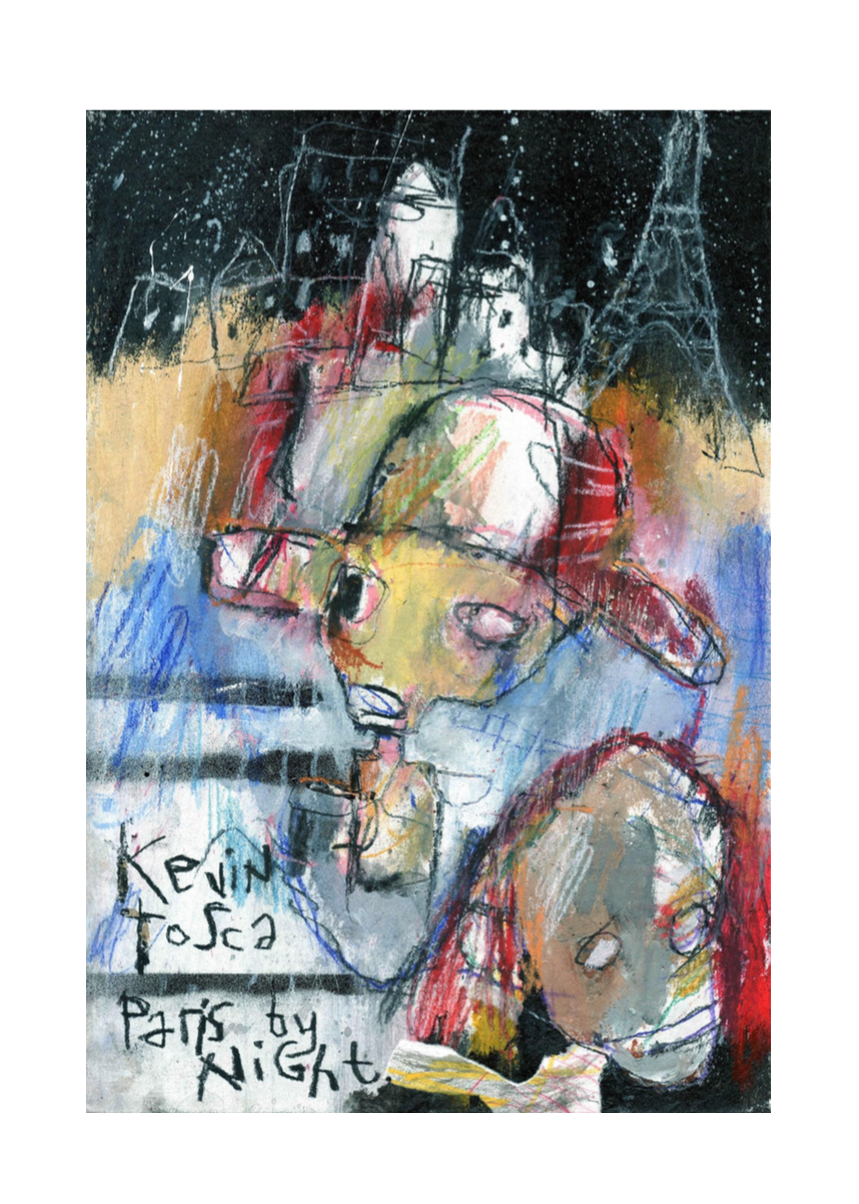
Tosca includes ten short stories in this chap, including seven which were previously published in The Frogmore Papers, The Interpreter’s House, The Broken Plate, Mojave River Review and Otoliths. Despite the romantic associations of the title these are dark, satirical takes on France as a tourist destination especially after the 2015 terrorist attacks on the offices of Charlie Hebdo and on the Bataadan Theatre in Paris. Similar to Ted Hughes’s poem “My Paris”, Tosca grimly exposes the underbelly of the city beneath its tourist façade.

The striking opening short story with the ironic title "Progress" peels away the surface to reveal the political undertones of world realities. Click on to enlarge:


Best of the short stories include “War Drums” and the titular “Paris by Night” in which Tosca satirises the best selling but insipid travelogues of France aimed at well-healed American tourists. 

Tosca’s collection of short stories is certainly amongst the best of the work published by Holy & Intoxicated Publications since its inception.

 Interview with John D. Robinson- PunkAndPoetryPodcast- Episode 2

Zine editor and poet Martin Appleby (of Paper and Ink), interviews poet, writer and publisher John Robinson (of Holy&Intoxicated Publications).  Robinson talks about alcohol & writing, his writing process, his Holy & Intoxicated Publications and what to expect from him in 2020. Find the postcast here (11:04-26:43m): https://soundcloud.com/punkandpoetrypodcast/punk-and-poetry-podcast-002

See also recent updated interview of John D Robinson by Catfish McDaris: http://ppigpenn.blogspot.com

For more information about the books contact publisher John D. Robinson here: johndrobinson@yahoo.co.uk

Tuesday, June 12, 2018

Book Review/ Interview: Catfish McDaris. 27 Hammerheads Circling Ever Closer. Pski's Porch, 2018 (318 pages)


This is an amazing, mind-blowing anthology of Catfish McDaris’s new, old and collected writing over an unspecified number of years. It includes more than a hundred poems, eleven pieces of flash fiction and three extended short stories “Naked Serial Killers in Volkswagens”, “Cocaine Nipples” and “The Painter”- which comprise roughly half the book.

The poetry is characteristically free verse and narrative in form. The poems usually sit comfortably on one page and most are about twenty lines in length. The poetry is extremely varied in subject matter and full of surprizes for the adventurous small press reader. You never know what to expect from one page to the next to the page after that. A prose poem sex romp, and poems about Billy the Kid, Van Gogh and Hendrix appear within a few pages of the book’s opening. The poems move from first to third person, from anecdotal social realism to the surreal or the supernatural or the absurd. The poems often feature a man known as ‘the Spaniard’ and his exploits are told with good humour, wit and exuberance. McDaris’s language is full of inventive word play and explicit sexual and drug references. 


The poem “Blue Desperado” on page 2 provides us with an early morsel of what to expect:

Blue Desperado

Apacho Comancho could hear a fly
fart in a hurricane, when he strutted
down the avenue all the vaginas
palpitated pulsated and pounded

Apacho was the motherfucking cats
meow, Mr. Love ‘em and Leave ‘em
he left all the ladies a hot mess under
duress, dancing into the garden of

Earthly delight with lightning bugs
tangoing in the air and swimming in
the dark oceans of the night, panthers
wrapped around him in legs and torso

Comancho bought a white stallion, so
white it was blue, he rode west and
crossed rivers of blood, his heart was
poisoned, his horse and he became one.

(all work posted with the permission of the writer)

Some of the more memorable poems include “No Longer Here”, “Neptune”, “A Horseshoe and 7 Flies and A Bowl of Tiger Soup”,  “How to be a Small Press Success”, “A Gringo Taco”, “The Kangaroo Blues”, “Feeling  Bit Queered”, “Flashing Back”, “Oh Woof”, “Help Me Please, God”, “The Weasel and the Beaver”, “Make Your Move”, Guaymas”, “Van Gogh’s Spinach” and “Birdman from Albuquerque”.

This book is interestingly “dedicated to all jailbirds, shoeshine boys, bricklayers, hod carriers, wig slingers, war veterans, skeezers, the Red Hot Chile Peppers, plumbers without the crack, dog walkers, cat lovers, potters, painters, postal workers, and the bones of Charles Bukowski.”

The title poem is a tight, inventive piece with a catchy name. In the interview with Catfish McDaris which follows this review, he remarks about the poem, “I chose the title first. I just read it, I couldn’t remember it. That’s a fucking killer shape shifting poem, I love it. I’m always writing lines, I never know where they’ll go.”

27 Hammerheads Circling Ever Closer

Six mailboxes of rejects, a geisha
with crotch-less panties in a blue
silk stork robe, Confucius love,
the fear of God and love of sin

Don Quixote eating peyote, while
wolves, grizzlies, Tasmanian devils,
and cat-sized mosquitoes try to
drain your blood in murderous rage

She never knew I was a legerdemain
Charlatan holding hands with magic,
27 hammerheads circling ever closer.

The front cover is illustrated by the Swedish artist Janne Karlsson. In it, a McDaris look-alike smokes a cigarette and strides a hammerhead shark. He spills a cup of coffee as he sinks a large kitchen knife into the beast’s snout.  The back cover consists of two drawings by LaWanda Walters.

The best of the book’s eleven pieces of flash fiction tend to focus on McDaris’s experiences as an artilleryman in the U.S. Army in the early 1970s, in boot camp and later in West Germany after Nixon stopped sending troops to Vietnam. The stories “Dutch”, and most important of all, “Little Vietnam, Tigerland Fort Polk, Louisiana” are fascinating and candid accounts of army life. 

Also memorable is the flash fiction which morphs from realism to a more mystical realm. “The Beautiful Monster” and “Spaniard’s Odyssey” evoke journeys where anything is possible. Consider this last paragraph from “Spaniard’s Odyssey”:

“The maiden led Spaniard up a ladder and down another ladder into a round kiva. They became one, they were contented like timber rattlesnakes sunning themselves on a granite mountain ledge. They could hear grass and corn growing, rivers singing, the ghosts of the ancient ones laughing and chanting. Kokopelli’s flute whispered and echoed, a feather dancing in the air. When Spaniard awoke, his lady had vanished. He could hear a bear growling above the kiva. Instantaneously, Spaniard became a butterfly, he flew into the bear’s mouth. Before the bear could swallow him, he flew away.”

Despite the crafty imagination and ongoing experimentation in McDaris’s poetry and flash fiction, what sets this book aflame and distinguishes it from the typical tread mill of egotistical small press mediocrity, is the daring and downright crazy storylines in his extended fiction. The three extended short stories in the book “The Painter” (51 pages), “Cocaine Nipples” (26 pages) and “Naked Serial Killers in Volkswagens” (64 pages) are full-on original and amongst the maddest shit I have had the pleasure to read for years.

The most accessible of the three is “The Painter”, a road journey about an attractive male artist called Nicky Moon whose specialty is capturing women in his art in the throes of orgasm. This story unfolds in nine parts and is essentially a fuck feast told in the form of a tall story. It follows Nicky’s pursuit of art and pussy and reaches a surprising climax after he pops some peyote buttons and straddles the enchanting and mysterious Sky. 

The story “Cocaine Nipples” is far more experimental, particularly in its bizarre evolving narrative and use of open-ended structure. The story is a loosely connected series of vignettes which progress preposterously to an unimaginable conclusion- even for the writer. Words, ideas, plot lines slip, bend, contort in impossible angles. A late-blooming hunchbacked butterfly eventually emerges but you cannot recall how the story actually arrived there. 

How do you explain the story without spoilers? Let me just say that the plot includes a mass-murdering possessed mink stole, an artist who paints people eating finger licking chicken thighs and drumsticks, a bloke who sells squirrels to a tiger owner and a haemorrhoid patient who spack-fills his asshole with crunchy peanut butter and non-toxic glue to pay back a group of proctologists from hell.

The highlight of this book is certainly the short story “Naked Serial Killers in Volkswagens” which I recommend you begin this book with.  The unlikely title derives from the 8 chapter titles of the story which are named after American mass murderers- Charles Manson, John Wayne Gacy, Aileen Wuornos, Gary Leon Ridgway, Jeffrey Dahmer, Velma Barfield, Ted Bundy and David Berkowitz. The baddies usually enter the story incidentally in the last paragraph or two of the chapter and don’t really affect the direction of the plot. 

The short story begins with Roxi and El Bagre eating spaghetti and sausages in Little Italy but after an old hippie boards their train, Bag drinks Southern Comfort and drops capsules of mescaline with the bloke, and the story, like Bag, enters a black vortex in which two ancient First Nations tribes are pitted againgst each other to fight to the death. The writing is ingenious, totally off-the-cuff and mad to the limit. Sometimes the point of view, storyline or characters disappear within a paragraph and morph into another arc. At one point in Chapter 8 the narrative even bursts into a series of dead-pan jokes. Here’s a lame one”:

“How about the drunk staggering into the Catholic church? He makes it into confessional and the priest says, tell me your sins my son. There is a long silence, the priest repeats himself to no avail. Finally he bangs on the wall and says you must confess. The drunk says, quit banging, there’s no toilet paper in here either.”

27 Hammerheads Circling Ever Closeris a highly inventive, bold collection of poetry, flash fiction and extended short stories by the Milwaukee based American writer Catfish McDaris. The anthology is a rich and diverse body of work and is hugely entertaining. You will find the best stuff in McDaris’s extended fiction. It may be uneven and outrageous but also insanely funny!

 Further Resources 

Marquette University- Special Collections and University Archives- Catfish McDaris, 1993-2013: http://www.marquette.edu/library/archives/Mss/CMC/CMC-series1-1.php


13 Questions of Catfish McDaris- Horror, Sleaze, Trash: http://www.horrorsleazetrash.com/interviews/13-questions-with-catfish-mcdaris/

Desolation Angeles- David Blaine Interviews Catfish McDaris: http://fitzroydreaming.blogspot.com/2011/12/david-blaine.html


INTERVIEW WITH CATFISH McDARIS ON 8 JUNE 2018

Why didn’t you seriously start writing until your 30s? What were the circumstances that prompted you to finally get it down on the page?

I dropped out of school in the tenth grade. I was already a journeyman bricklayer, so I had a trade. I got my GED High School Diploma in Boot Camp, then took classes in German and from the University of Maryland. I wrote long letters to family and friends while I was in the army in Germany; describing Europe and army life. For two and a half years I shot cannons and played war games. I also saw lots of castles and went to Amsterdam often. I raised lots of hell and spent nine months at a nudist colony, when I wasn’t playing soldier. I am autodidactic, I read everything. Classics, French, Russians, English, Americans, and Chinese. I needed to teach myself as much as I could, before putting ink to paper. In Milwaukee I went to poetry readings, I got on stage and felt like a rock star. I discovered the small press, it was still the SASE days, no internet. It was great fun; my wife wouldn’t agree or our daughter. Now I say I’m like an inside dog, I only do it on paper. If somebody paid me enough I’d hit the wood again. I’ve done some radio blog shows from home that were cool, one was with Lady Gaga’s violinist.

In David Blaine’s 2011 interview, you refer in detail to your early life before the post office and your marriage. How has this period helped to initiate and shape your writing?

David Blaine is a good writer, he met Carl Sandburg’s youngest daughter, Helga. The army taught me discipline, which is important to work at the Main Post Office in Milwaukee. Writing and reading provides sanity. Love of a good woman and a baby keeps your head straight and keeps you putting beans and tortillas on the table. As they say now, you got to man up.

Over how many years was the material in 27 Hammerheads written? Has much of this stuff been previously published?
 
Dr. Marc Pietrzykowski (PhD) is Pski’s Porch, he’s a professor near Buffalo, New York. He plays 5 or 6 instruments, with 5 string bass being his main stay. I sent him Sleeping with the Fish, a year before 27 Hammerheads Circling Ever Closer. Marc said he didn’t publish flash fiction, he preferred poetry or a novella. I told him give it a go. He wrote back, he said cool. We did that mixture of words. Then we did a tribute to Vincent van Gogh called Resurrection of a Sunflower, then we did 27 Hammerheads. Most of these books are new, old, and collected. If someone paid me or I have a contract on my words, I don’t give credit. The small press doesn’t get enough exposure as it is. If I ever hit the big time, I’ll have my agent deal with where, who, and how. I’m too fucking old for that shit anyway.
Titles come to me, I had a 10 poem chaps called: 72 Magpies Fucking Over Buffalo, also: 66 Lines on Your Soul. Something about numbers are a hook.

What editing process was involved in the publication of 27 Hammerheads? Did you simply send Pski’s Porch a shit-load of work and they published the lot or was the process more elongated and refined than that?

Marc and I get on the same page before layout. We are partners, but he’s still the boss. We trust each other and work well together. Mendes Biondo from Northern Italy has joined us since our Van Gogh book. We do Ramingo’s Porch. Our third issue I rounded up all my old Bukowski and Jack Micheline contacts. Your question was the process elongated and refined, reminded me of a guy hard up for a job. He sees an ad that says they are looking for a piss tester, so he goes and applies. When arrives he sees the ad is actually looking for a piss taster.

I note that you adopted the title of the book from the poem “27 Hammerheads Circling Ever Closer.” Can you explain why you chose this title apart from its intriguing name?

I chose the title first. I just read it, I couldn’t remember it. That’s a fucking killer shape shifting poem, I love it. I’m always writing lines, I never know where they’ll go. As soon as I contacted my Swedish maniac genius, Janne. He said Cat I have your cover and LaWanda did my rear cover. Intrigue is the hook.

‘The Spaniard’ features in many of your poems and flash fiction. Is he your alter-ego or simply an imaginary character to unleash your stories?

Years ago, a writer I respected and still do, Todd Moore told me I was writing “brag poetry and fiction” step away from your work, people will dig it more. Spaniard comes from the last town I lived in in New Mexico, Espanola. I used Quick from a childhood hero, Danny Quick. I used Nappy because of my nappy hair. El Bagre in Killers just means catfish in Spanish.

You gave up the booze many years ago but make many other drug references in your work- usually to ganga or peyote. Do you sometimes write under the influence?

14 years now with no ignorant oil. No other drugs except coffee and Xanax. Back in my hippie days, there is nothing I wouldn’t try, except datura stramonium (Jimson weed), after one time with that I almost lost my mind. I took lots of acid, peyote, sotol, mescaline with Huichols in Mexico.  I preferred psilocybin mushrooms from southeast Texas compared to all the psychedelics I experimented with. I loved weed smoking: bongs, blunts, chillums, fat boys, pinners. Lots of hash in Europe. I read the top 4 of 5 most powerful marijuana strains grow in Australia. My street drug days are long over. I do not recommend alcohol or drugs for anyone.

I really dig your novella Naked Serial Killers in Volkswagens. I was wondering if you could provide some background as to how you wrote it and how you eventually pieced it together?

Serial killers are a touchy subject in Milwaukee because of Jeffrey Dahmer. He picked up most of his 21 victims close to where I worked. He worked for Ambrosia Chocolate close to the Milwaukee Post Office. There were lots of gay bars and art galleries in the area. I read poetry with various musicians. I met Dahmer a few times and he bought chapbooks from me. I think he wanted to make a snack of me. The cops caught him finally. They came to my house and wanted to see if I was a cannibal too. They put Jeff in prison, he lasted 8 months before he was shanked. For those 8 months, we got 3 to 5 bomb threats a week, people trying to blow his ass up. I watched the movie, Monster about the woman serial killer and threw in Manson. There is so much evil in this world. It seemed like they all had to be naked and vilified driving VW’s.

You said in a previous interview that you write for fun and to entertain your audience. As you grow older, do you consider that you may have a higher purpose?

I never tried to make big money by writing. It’s still fun for me. I’ve won a few awards and been nominated for tons. I like meeting people from all over the world and with the web it is possible. I’m working on three novels all the time, while taking lots of detours.

You store 25 years of your published material in the Special Archives Collection at Marquette University in Milwaukee. Where would you suggest a future literary biographer to begin the exploration of your published work?

Go on the Marquette site and click on the series boxes, that will tell you about some of the places I’ve been published. They collect all current paper publications and electronic, so this interview will be in the archives. Just Google Catfish McDaris. I try never to search my name, it’s too ego inflating. Once I found a long interview I did with the beatnik, Charles Plymell. Some one had translated it into Esperanto. We didn’t get paid, since it has no money or country.

What on the cards next for you?

I’m still editor at Ramingo’s Porch and contributing odditer for Odd Books in Kolkata, India. I have a couple of broadsides coming soon, one from 48th St. Press and another from Holy & Intoxicated, I’ve made a few other scores. Thanks George, you run a tight ship.

Thanks for dropping by, Cat.


Bio: Catfish McDaris’ most infamous chapbook is Prying with Jack Micheline and Charles Bukowski. His best readings were in Paris at the Shakespeare and Co. Bookstore and with Jimmy"the ghost of Hendrix"Spencer in NYC on 42nd St. He’s done over 25 chaps in the last 25 years. He’s been in the New York Quarterly, Slipstream, Pearl, Main St. Rag, Café Review, Chiron Review, Zen Tattoo, Wormwood Review, Great Weather For Media, Silver Birch Press, and Graffiti and been nominated for 15 Pushcarts, Best of Net in 2010, 2013, 2014, 2016, and 2017 he won the Uprising Award in 1999, and won the Flash Fiction Contest judged by the U.S. Poet Laureate in 2009. He was in the Louisiana Review, George Mason Univ. Press, and New Coin from Rhodes Univ. in South Africa. He’s recently been translated into Spanish, French, Polish, Swedish, Arabic, Bengali, Mandarin, Yoruba, Tagalog, and Esperanto. His 25 years of published material is in the Special Archives Collection at Marquette Univ. in Milwaukee, Wisconsin. Bukowski’s Indian pal Dave Reeve, editor of Zen Tattoo gave Catfish McDaris his name when he spoke of wanting to quit the post office and start a catfish farm. He spent a summer shark fishing in the Sea of Cortez, built adobe houses, tamed wild horses around the Grand Canyon, worked in a zinc smelter in the panhandle of Texas, and painted flag poles in the wind. He ended at the post office in Milwaukee. 


Tuesday, May 15, 2018

Book Re:release: Catfish McDaris Prying Refried. Ppigpenn Press, 2018 (32 pages)


This chapbook anthology was originally published in Prying Magazine by FOUR-SEP PUBLICATIONS in 1997 and features the poetry of Charles Bukowski, Jack Micheline and Catfish McDaris.

The book’s colophon carefully explains, “Works by Jack Micheline have appeared previously in various form and are published with his explicit permission. Charles Bukowski gave these four poems to Micheline in 1974. They were friends. Bukowski was living at 5437 2/5 Carlton Way, Los Angeles Ca 90027 when these were written. They are used with all-three owner’s permission. Catfish McDaris’ original works appear with his explicit permission. At the time this special edition was published, Catfish helped Jack financially and they were friends until Jack’s death.”

Charles Bukowski’s poems include “Help Wanted”, “d.n.f.” , “Extant” and “to weep in her ear”.

“Extant” is clearly the best of Bukowski’s in the collection and shows off his anaphoric, incantatory style. Interestingly, the last page of the three page poem first appeared as “blue moon, oh bleweewwmoooon how I adore you!” in Sparrow Magzine (1975) and later in book form in Play the Piano Drunk Like a Percussion Instrument Until the Fingers Begin to Bleed a Bit (1979).

Jack Micheline’s brief bio includes a blurb by Bukowski, “Micheline is a flowing, jostling master. A jew drunk singer, very fine. He knows best the betrayals, the pavements, the whores with lemon rinds up their bungs, and the lice in the spotlights.”

The chap includes the street-wise relevatory classics “The Song of Kid Willie”, “My Philosophy”, “Walking in Kerouac’s Shadow”, “Tonight I Push My Wagon Into the Night Sky” and “The City”.

The third contributor, Catfish McDaris lives in Wisconsin and has organised the republishing of this book. His poems are smart-assed and in your face and include “The Ass That Wouldn’t Quit”, “If the Moon Had a Pussy I’d Fuck It Doggie Style”, “Cape Valentine”, “She Loved Me Because Of Poetry” and “Antelope Dream”.


Friday, March 30, 2018

Featuring Catfish McDaris


Mr. Boris

The nickel sized spider lived between the double storm windows and outer window. Fierce winters required three panes of glass. The spider was yellowish black with reddish gray stripes on its barber pole like legs. It couldn’t get inside, I pointed that out to Paola, it was in our second-floor bedroom. Petunia the cat loved to peer out the window to watch the spider and the birds and squirrels. I called the spider Boris. It spun a beautiful web, I tried to get it out three times with a bent coat hanger. Boris hid and came back after each attempt. It had a marvelous iridescent web that reflected the sunlight perfectly. It was completely stocked with a plethora of food. Two green aphids, a fat mosquito, a copper centipede, an ant, and some alien looking beetles. One morning I took some wire and jammed it between the windows, breaking and bloodying a fingernail and knuckle, but Boris was gone. Paola saw it and screamed are you getting outsmarted by a spider. I took out the three panes of window and screen, I had Paola hold an old shower curtain over the window. I took a garden hose and blasted water up there. I told Paola it has to be washed away, she watched as I started reassembling the window. It was far from easy balancing the heavy glass in the wet metal window tracks. Here comes wet Boris, mad as hell landing on the back of my hand running up my shirt. I slam my chest into the wall, while juggling three panes of glass. Paola screams, I thought I killed Boris. The windows slams down on the backs of my hands, like a guillotine. One hand soon looks like raw hamburger someone beat with a meat hammer and an artery is swollen like a blue worm. The other hand looks like it’s been slammed in Cadillac door. I think both my hands have black eyes. Paola got me some ice and said, “At least you killed that ugly ass spider.” I didn’t tell her Boris had moved into my closet.

            “Hey Fish, thanks for not ratting me out.” I thought it was a dream or those funky tacos I had washed down with Mad Dog the night before.
            The voice was kind of squeaky like a cartoon character, maybe Bugs Bunny.
            “Call me Mr. Boris. I’ll only speak to you when I feel like it.”
            The spider took a couple of flexed jumps on its web like a trampoline and then did some flips. “Don’t go insane on me human. I can help you write, just take me outside to catch some juicy insects.”
            “Okay Mr. Boris, show me what you have.”
           
“Red necks in the chicken coop
making cackle whoop whoop

A closet full of homos wearing
shoes and socks like Perry Como

His mama was a cougar
he liked to eat his boogers

Chocolate man was a nigerette
he rolled a marijuana cigarette

Driving a Chevy drinking with a ghetto lean
Leroy changed his name got cut in the spleen”

“That’s enough Mr. Boris, your rhymes are so bad you’ll get my ass kicked for sure. I’ll burn bridges north and west, I’ll have to carry a derringer in my vest.”
“Not too shabby, Fisherman.”
           

The Sandman

He low crawled to the top of the sand dune and stared down at the oasis. Five nomads were watering their livestock. Nappy kept his rifle scope trained on each of them and shifted his hand grenades to a more comfortable position. He signaled to Qadr and she disappeared down the trail to where Nahla was guarding their animals. Most nomads were honest, but there were rumors of bands of thieves roaming this area. He’d learned long ago the best ways to stay alive. The five men left the oasis, headed east. Waiting until it was safe, Nappy’s entourage approached. 
       Nappy relaxed during the hot afternoon. The palm trees yielded shimmering shadows over the refreshing cool oasis. Sand dunes and mirage visions fought wars across the vast oceans of desert as far as you could see. His only wife, Qadr, who’s name meant fate, he’d met while living among the Blue Men of the Tuareg Tribe. Her beauty was unsurpassed. Nappy loved her so much, it frightened him at times.  She had only one servant, Nahla, which meant a drink of water. Often Nahla had found water for them and their camels, goats, and sheep, when they became thirsty on their journey. 
       Abdullah, Nappy’s Bedouin friend could not believe he’d wanted only one wife, when he could’ve had many or a harem of beauties. Nappy was excellent at raising livestock and racing camels. He could’ve been wealthy in gold, instead he was a seeker of knowledge. They watered their stock, then made camp a few miles away from the water. Where there was water in the desert, there was danger. Something woke Nappy, it wasn’t a sound exactly, it was more like a feeling of dread. Something was amiss. One camel and Nahla had vanished, she was on guard duty. Qadr and Nahla were always armed to the teeth. Nappy pursued the tracks leading toward the oasis.
       The five nomads were taking turns raping his camel. Nahla was hiding, invisible to all, but Nappy. For men to hurt animals was unthinkable, it was a crime against God. Nappy was enraged, he became a monster killing machine. He waded into them like the devil incarnate. Bones were broken, heads and limbs were separated from torsos, blood soaked deep black into the sand. The camel trampled the last man to death. Nahla had seen Nappy in battle and knew enough to keep out of his way. She kept her rifle trained on the ferocious melee, in case her assistance was required. She filled a bucket of water for Nappy to wash in.
         Nappy helped Nahla drag the corpses away from the water. The desert was quiet as the red orange sun peered above the sand dunes. Spotted hyenas were ready to feast, vultures circled above.                           


Writer, Painter, Thief, Killer


I love mama poems, no dada
poem for mama in heaven
best poem for mama
mama poems birthday
my mama poems
mama poetry in blood 
poems on mama in Hindi
dear mama poem
mama naked poem

Chasing broncos, ghosts, and ladies through the night

A guy ticks off his mama, she beats him in the head with
a toaster then puts his penis in, plugs it in and clicks
it down to bagel setting.


The Biggest Joke is Death


exploring nature, red wagons,
animal love, family, China, the
Arabian desert, quiet birds, burning
books, condoms, Bibles, poet hats,
coffins, cowboys, virgins, ghost
snakes, dog tags, and cannibals.

there is even some sex, but never
enough just a toe dip into the river,
shackled by my years, gravity sucking
my energy, the sky and ceilings piss
on my head, the walls yawn in boredom,
nobody laughs at the ugly motherfucker.


Even Death Can Make a Mistake


Love is a huge blood diamond
shoved up the ass of a virgin Zulu

Love is an alligator’s yellow tooth
worn by a gypsy mojo priestess

Love is a black baby dying of starvation

Love is a palomino stallion falling
into the Grand Canyon

Love is the workers getting overtime
wages on the Great Wall of China


There is no such thing as love.


Bio: Catfish McDaris’ most infamous chapbook is Prying with Jack Micheline and Charles Bukowski. His best readings were in Paris at the Shakespeare and Co. Bookstore and with Jimmy"the ghost of Hendrix"Spencer in NYC on 42nd St. He’s done over 25 chaps in the last 25 years. He’s been in the New York Quarterly, Slipstream, Pearl, Main St. Rag, Café Review, Chiron Review, Zen Tattoo, Wormwood Review, Great Weather For Media, Silver Birch Press, and Graffiti and been nominated for 15 Pushcarts, Best of Net in 2010, 2013, 2014, 2016, and 2017 he won the Uprising Award in 1999, and won the Flash Fiction Contest judged by the U.S. Poet Laureate in 2009. He was in the Louisiana Review, George Mason Univ. Press, and New Coin from Rhodes Univ. in South Africa. He’s recently been translated into Spanish, French, Polish, Swedish, Arabic, Bengali, Mandarin, Yoruba, Tagalog, and Esperanto. His 25 years of published material is in the Special Archives Collection at Marquette Univ. in Milwaukee, Wisconsin. Bukowski’s Indian pal Dave Reeve, editor of Zen Tattoo gave Catfish McDaris his name when he spoke of wanting to quit the post office and start a catfish farm. He spent a summer shark fishing in the Sea of Cortez, built adobe houses, tamed wild horses around the Grand Canyon, worked in a zinc smelter in the panhandle of Texas, and painted flag poles in the wind. He ended at the post office in Milwaukee.