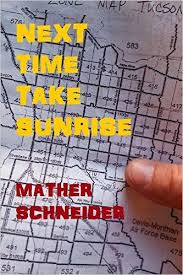
Schneider says candidly of breathing new life into his book of taxi-driving short stories, “I sent a story or two to Matt Forney and he put them on his website Terror House. I sent a few more and he put those up too. Then I sent an entire manuscript, which he said he would publish if I was interested.
“He hired a cover artist, proof-read it and made the book. We all know how easy it is to do that these days. But, at least he didn’t bother me about bullshit.
“I cut the book and also added to it, and now it is a different book, with a different title. It’s called “6 to 6” which was a normal shift driving a taxi cab, a.m. or p.m. I tried to cut the boring stories and keep the interesting ones. I also changed a lot of openings to get more “hooks.”
Most of the stories are told from the point of view of Matt Glasford, a hardened and cynical fortysomething taxi driver who works for Discount Cabs in Tucson, Arizona. Many of his passengers are disadvantaged or elderly and are given vouchers which enable them to travel free. Much of our interest in reading these stories derives from the ongoing congo line of eccentric and damaged people that Glasford has to ferry about and his growing resentment towards them.
The writing is clear and easy to follow. As in his excellent collections of poetry He Took A Cab (NYQ Books, 2011) and Prickly (NYQ Books, 2017) the reader is a fly on the wall inside Schneider’s cabs and we gain an appreciation of the shit that cabbies have to endure- the long hours, the threat of physical violence, the poor and insecure wages and conditions, the boredom, and the occasional displays of humanity and compassion which sometimes make the job almost bearable.
Some of the better stories are more complex and unpredictable and often are character driven studies of his passengers or fellow cab drivers. ‘Next Time Take Skyline’, ‘Morenci In My Rear-View Mirror’, ‘The Thing People Understand’, ‘Bob’s Big Day’, ‘God didn’t Get Me No Weed’, ‘Turn Around, Dumb Ass’, ‘The Hideaway’, ‘No Way’, ‘Plasma’, ‘The Double’ ‘And Deliver Us From The Viking Amen’ and the meta-fictional ‘Somebody Say The Magic Word’ are highly credible and original. You can’t make this stuff up!
Perhaps the best and most entertaining story in the collection is ‘Drano’. It is a rare third person portrait of Cory, an ex-con who drives cabs after he gets out of prison. (The story is posted with the permission of the writer).
DRANO
It was not possible to pass a kidney stone the size of a golf ball. Cory wouldn’t be able to work until after the surgery, which was in a couple of weeks. He needed a break from that taxi cab anyway. He had been driving taxi ever since he got out of prison 12 years ago, 8 years for dealing meth. His old lady rolled on him and she got off scot free, not a day in jail, even though she did as much dealing and smoking as he did. She never wrote him or visited him when he was inside. When he got out he tried to contact her. He found her on Facebook but she wouldn’t talk to him and then she blocked him. They had a daughter who was 6 years old when he got put away. He found her too on Facebook. They talked briefly, once, and she told him it would be best if they didn’t communicate. He didn’t blame her. She gave him her address and he sent a money order every month. She was now 26 years old and had a new baby of her own. He was a grandfather.
He drove past Randolph Golf course on his way to Wine and More. The driving range was scattered with a million little white golf balls in the green grass, like stars in the sky. Men and women swung their sticks, thinking they were special, fit and tan legged cartoons. His doctor golfed every other day. The little golf carts puttered and bounced along in a big hurry. Martinis with olives waited in the clubhouse.
At Wine and More he could hardly walk the aisles. He walked like he had walked that first time in county jail in Los Angeles, years before the prison stint: one foot in front of the other, slowly, head down. One inmate had stepped out of line and the guards jumped on him and beat the shit out of him with their sticks. It was hard to keep track of the timeline. What was it, 34 years ago? He had been only 21. This was before the meth, 1983 or 84. He had been arrested for multiple driving offenses, marijuana and coke. He chuckled to think of it now. For years he had struggled to let it all go but somehow now he wanted to hold it close to him.
He bought a case of beer and drove slowly back to his apartment. The sun bubbled in the sky like a tick swollen with spoiled butter. How did he ever get to Tucson? Cars and trucks tailgated him and zipped past, only to brake violently and come to hard halts at the red lights and sit there stewing, angry at the universe, though the universe probably didn’t do it on purpose. He used to drive like that. Now he realized it made no sense, it did no good. It hurt to brake, it hurt to accelerate. It hurt to breathe.
His apartment was on the third floor and he had trouble climbing the stairs. Inside he opened a can of beer and sat down to his computer. He popped a pain pill and took a sip of the cold beer. He opened Facebook. Every now and then he posted a photograph of the cosmos, all that space above and around us. There was something calming about the photographs of the galaxy and the stars and the Milky Way, black holes and lazy galactic winds, telescopic photographs that he found on the internet. Planets. Jupiter was his favorite with that red storm like a half-developed dragon fetus dropped out of an egg to poach in the churning atmosphere. He posted these photographs on Facebook without any words. What explanation could he give? Nobody ever “liked” his posts or made comments, which didn’t bother him. He didn’t reach out to anyone, he never trolled. He minded his own business.
In the Los Angeles county jail, the cockroaches were the size of mice. At least he remembered it that way. He was in there for 29 days. Every few days he was given his street clothes and transported to a different court around the county to be judged and held accountable for the several infractions of which he was accused. Why all of the infractions couldn’t have been dealt with in one court on one day was one of those mysteries. None of it made any sense to him. He followed the guards, one foot in front of the other, handcuffed, head down. He was never asked questions. Other people did the talking. The judges sat smug and mighty and fat, sexless ghouls with warty souls. He was always given “time served” and then he was transported back to jail. It was like a game.
In county jail his cellmate was a kid of 19. The kid had broken into a historical Tucson building and lit a fire and the building had burned to the ground. Before Cory even got snagged he had seen it on the news, the fire trucks throwing vicious arcs of foaming water into the inferno and the inferno just absorbing it. Later the ashes and cinders of the building, the brick walls still standing burnt and blackened. The news people made it sound like the “arsonist” was a hardened gangster devoted to the complete destruction of society. And there he was, just a zitty kid laying in the top bunk above Cory, crying. He was awaiting trial and would most likely do 20 years for burning that building. He told Cory he and a buddy had been fooling around, lit a fire in a garbage can for kicks and then it got out of hand. No sprinkler system in the old building. The kid’s buddy had turned him in. Cory celled with this kid for a couple of weeks, heard him jacking off in the night on his bunk and tried not to look when he shit in the toilet 5 feet away. Then they took him one morning.
The food in county jail was terrible, but mealtime was still the highlight of the day. In the morning all they got was bread, cheese and coffee. In the evenings they got a little more. On Fridays they got a hot dog and beans. One Friday Cory was in line at the food window and the inmate who was standing in front yelled out: TWO HOT DOGS TODAY! Everyone in line became excited. But as soon as the screw slid the food tray to the front guy everyone knew they had been duped. The sadistic cooks had sliced each hot dog longwise and placed them on the trays in such a manner to make it look like two. One inmate laughed and got his ass beat later. Cory laughed to think of it now. There was almost a tenderness in the thought of it.
On his 29th day in county jail Cory was again given his street clothes and transported to another court to stand before another judge. After it was over he was led to a door which he assumed would lead to the white van that would take him back across the county again. The guard took off his handcuffs and opened the door. When Cory walked out the door shut behind him. He stood there alone behind the court house looking at a freeway ramp. He was free, apparently. But what about his belongings? What about procedure? What the fuck was going on? He walked around the courthouse
building to the front door and asked a few people and finally ended up in a clerk’s office. The clerk told him his possessions were in the LA county jail and wondered why Cory was so stupid to have left them there.
It took him a day and a half to walk back to LA county jail. When he arrived back at the “glass towers” as they called it back then he asked around and finally another clerk told him that his belongings were at the original jail of arrest in Newhall, 100 miles away. He had no money, no way to get there. The clerk told him of a thing called “traveler’s aid” which he could get at the Greyhound bus station. He slept on the street again and the next day walked into the Greyhound station. He told the ticket lady his story and showed her his jail ID which was all he had. 2 hours later she told him she couldn’t get him all the way to Newhall but she could get him somewhere nearby.
He had not eaten for 3 days. He slept on the bus. He woke up as the bus was pulling away from his stop. How he knew it was his stop is one of those mysteries, something in his dream told him. He jumped up and yelled at the bus driver, stumbled down the bus steps into the darkness.
As he walked the dark road to Newhall a cop stopped him, his campfire top lights swirling in the quiet country night. Cory told him his story and the cop ran his ID and found out he was telling the truth. He gave him a ride into the town jail. He knocked on the jailhouse door which was locked. Someone came and told him he was lucky because they were about ready to leave. The officer let him in and disappeared for a bit. He returned with a big manila envelope and asked for Cory’s ID.
The officer dumped the contents of the envelope on the counter and there it lay: his wallet with a wad of money in it, a bag of pot, a pipe and a jar of cocaine. His life. The officer asked Cory if these were his. Lowering his head he said yes, sir, they were his. Then, without any other questions, the officer pushed everything over to him and said, Ok, there’s a bus stop about 3 miles up the road, good luck. Who can explain these things? No one would believe it, but that’s what happened. Outside he was high within 2 minutes and it was the best walk of his life.
He hadn’t learned a damn thing from all that and years later when he was 35 he ended up in the state pen for nearly 8 years for selling methamphetamines. After he got out he stayed out, cleaned up and found a job driving taxi. So many years sitting in that taxi, so many miles, driving, driving, going in circles, going nowhere. He could have driven to Alaska or down to Chile and back again. He could have driven to see his daughter and his granddaughter in Ohio dozens of times. He had no idea where his parents were or if they were alive. When he was 17 his parents went on a vacation to Ireland and never came back. Ireland of all places! He’d tried for years to find them and even now he searched for them on Facebook. They could be dead. Or maybe they changed their names. They could be any of a million anonymous voices that scratched their pathetic pleas onto the screen.
Somebody knocked on his apartment door. He hobbled over and opened it: the girl who lived a couple apartments down in number 8. She stood there fidgety, looking around in a paranoid manner. She was as thin as a corn stalk except for the pregnant belly. Her fingernails looked like she’d clawed her way out of a worm bucket. She held a coffee cup.
“He dude,” she said. “Can I use your microwave?” “For what?”
“To heat this up.”
It wasn’t coffee.
“What the fuck is that?”
“Just a little Drano.”
“I don’t think so. I heat food up in my microwave.”
“It’s in a cup, man!”
He shut the door. She knocked again. He ignored it. Finally she screamed, “Bastard!” and stomped away.
Those amateurs were trying to cook meth right in his building. The place might burn down one night. He sat and looked out his front window. He thought of his old cellmate, the kid in county jail who had set fire to the historical building. He should be out of prison by now, if he lived through it. Maybe he could look him up on Facebook? What was his name? For a second he considered going down to the girl’s apartment helping her. He felt the old cold urge pulling him. But the pain from the kidney stones kept him from moving. Not even Drano could clean those things out.
Sitting at his computer he posted a photograph on Facebook, an image of outer space, just a random shot of some stars and a cloudlike cluster, ghostly chaotic, but with a kind of order and beauty. Maybe there was another planet with life on it out there somewhere? He opened the large manila envelope that his doctor had given him, much like the manila envelope that the jail clerk had handed him all those years before. He took out the X-ray and held it up to the window. His kidney stones shimmered, like shrapnel, a few small ones and that big one. His bones too, Jesus fucking Christ, his skeleton white and porous against the black background. He shuddered. If the stones weren’t removed, his body would fill up with poison and he would turn yellow and die. He looked at the picture of the kidney stones and he looked at the picture of outer space taken by the Hubble telescope. Then he went to his daughter’s Facebook page and looked at the photographs of her holding his granddaughter, Muriel. She was a fat little creature, like an alien. He imagined her squirming to escape her mother’s belly. He talked to her with his mind, and she understood what he was saying, and she gave him a fragile smile.
The pain diminished a little. He stood up, went outside to the landing of the apartment building. The sun was setting and it lit him up and cooked him. The landing was old and rickety and crooked and slanted down and outward from the apartment building so that you were always being pulled toward the bars of the loose railing. Slowly he made his way to apartment 8, like a man with a limp, or a lost child walking crosswise on a hill or across the tilted floor of a movie theater. He heard people moving inside the apartment, sharp words, and noticed the familiar chemical smell coming out of the air conditioning unit. He imagined that was what the earth smelled like when it was young and steaming and toxic and there was no life yet. Either that or the smell of the earth after humankind had burnt it all up. The windows were covered with old newspapers taped around the edges. One of the newspaper pages was the comic page, but it was upside down and Cory couldn’t read it.
He was about to knock on the door when he heard the explosion. The landing shook like a small earthquake, or like when you’re driving over a bridge with 18-wheelers and wind. The front windows shattered and the glass spit out at him like shards of crystal saliva. The door of the apartment opened and a man stomped out of the smoke, barefoot and bald, a tattooed shirtless devil with an ossified face. He knocked Cory off his feet as he ran off down the landing toward the stairs, which seemed a million miles away. The smoke rushed out inky and billowing and the torn newspapers that had covered the windows curled in filthy orange flames. The girl was still in the apartment with her baby in her belly but Cory could not get up. His kidney ruptured. He lay on the landing feeling the heat of the fire coming out the apartment door like a pizza oven. He rolled to the railing of the landing and gripped the bars. They were hot and he could feel his fingers melting. For a few seconds he saw the bald shirtless man running across the parking lot getting smaller. Then all his bones turned soft and he began to slip through the bars like an octopus. The air was like boiling liquid but it was as if he was born for it and it was salty and thick like blood and the screams he heard were like screams underwater. And then he was through and floating and he had dozens of arms but he couldn’t gather anything into them.
In 6 to 6 you will find non-bullshit, unembellished accounts of a cab driver trying to make a living in America. The language is fresh, realistic and highly entertaining.
Schneider presently lives in Mexico.
Buy the book here: https://terrorhousepress.com/6-out-now/
Find my 2015 review of Next Time Take Sunrise here: https://georgedanderson.blogspot.com/2015/11/book-review-interview-mather-schneider.html